

Vacuum Priming System Description
Vacuum priming system is not a pump - it is a system that lets the pump prime itself
A centrifugal pump cannot handle air. So whenever the impeller sits above the water level, the suction pipe and casing must be filled with water before every start - the step in pump-station operation that is most likely to go wrong, and the one nobody wants to do.
If any of these three situations looks familiar, this unit was built for it:
1. Priming at every start-up. A foot valve that does not seal means a leak at every prime; night shifts, rain and remote sites make it a job nobody wants.
2. Pump pits keep getting deeper. Where the water table is high, one flood shuts the station down; every extra metre of excavation costs money in civil works, waterproofing and dehumidification, and leaves a long-term risk behind.
3. Gas in the medium. An ordinary self-priming pump loses flow as soon as it handles a gas-liquid mixture; in the worst case it runs dry and the mechanical seal burns out.
What we do is simple: hand the job of priming to a vacuum tank and a liquid ring vacuum pump, and let them do it automatically every time.
Vacuum Priming System Working Principle
The working fluid of the liquid ring pump circulates as follows: fill the gas-water separator with clean water up to the overflow port, open the working-fluid inlet valve before starting the liquid ring pump, and clean water from the separator passes through the filter into the pump. The exhaust port of the pump is connected to the inlet of the separator. Under the diffuser effect the gas-water mixture separates: the water stays in the separator and rejoins the working-fluid circuit of the pump, while the gas is released to atmosphere.
Vacuum Priming System Composition
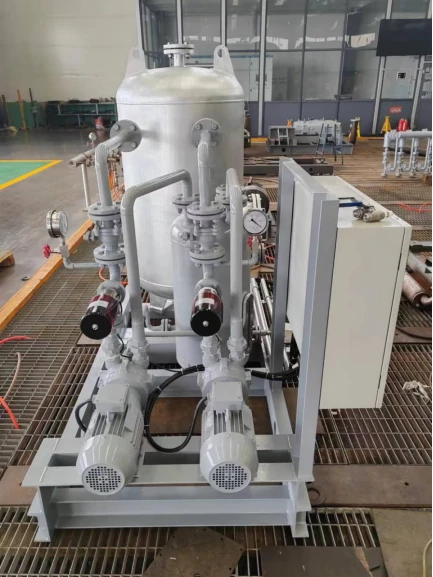
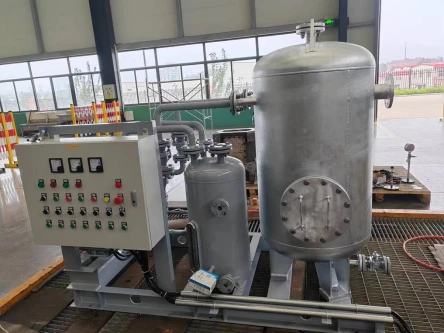
A vacuum priming unit normally consists of: liquid ring vacuum pumps (usually one duty, one standby), a separator, a vacuum buffer tank, a priming controller assembly, solenoid vacuum air-admitting valves, and so on.
Vacuum Priming System Technical Specifications
|
Tank volume (m³) |
Pump station model |
Recommended vacuum pump (liquid ring) |
Power (kW) |
Vacuum fluctuation range (MPa) |
Ultimate vacuum (MPa) |
Working port(mm) |
|
0.3 |
ZF-0.3A |
2BV2060 ×2 |
1.1 kW ×2 |
0~-0.09 |
-0.098 |
40 |
|
ZF-0.3B |
2BV2061 ×2 |
1.5 kW ×2 |
||||
|
0.5 |
ZF-0.5A |
2BV2061 ×2 |
1.5 kW ×2 |
50 |
||
|
ZF-0.5B |
2BV2070 ×2 |
3 kW ×2 |
||||
|
1 |
ZF-1A |
2BV2061 ×2 |
1.5 kW ×2 |
80 |
||
|
ZF-1B |
2BV2070 ×2 |
3 kW ×2 |
||||
|
ZF-1C |
2BV5110 ×2 |
4 kW ×2 |
||||
|
1.5 |
ZF-1.5A |
2BV5110 ×2 |
4 kW ×2 |
80 |
||
|
ZF-1.5B |
2BV5111 ×2 |
5.5 kW ×2 |
||||
|
ZF-1.5C |
2BV5121 ×2 |
7.5 kW ×2 |
||||
|
2 |
ZF-2A |
2BV5111 ×2 |
5.5 kW ×2 |
100 |
||
|
ZF-2B |
2BV5121 ×2 |
7.5 kW ×2 |
||||
|
ZF-2C |
2BV5131 ×2 |
11 kW ×2 |
||||
|
3 |
ZF-3A |
2BV5121 ×2 |
5.5 kW ×2 |
100 |
||
|
ZF-3B |
2BV5131 ×2 |
11 kW ×2 |
||||
|
ZF-3C |
2BV5161 ×2 |
15 kW ×2 |
||||
|
5 |
ZF-5A |
2BV5131 ×2 |
11 kW ×2 |
150 |
||
|
ZF-5B |
2BV5161 ×2 |
15 kW ×2 |
||||
|
ZF-5C |
2BV5161 ×3 |
15 kW ×3 |
Our Case
Below is a vacuum priming unit we built for a customer.
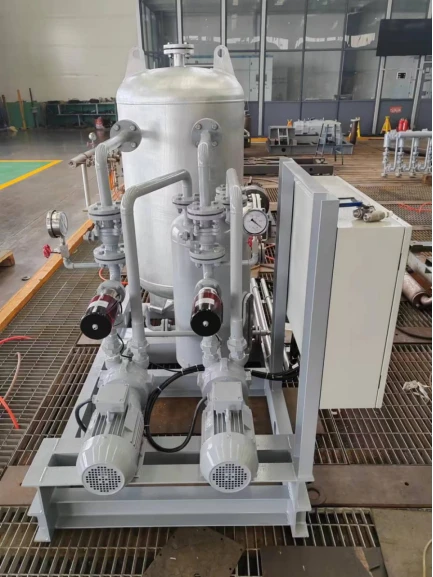
1. Model: ZFY-1
2.Main configuration:
Two 2BV2070 liquid ring vacuum pumps, 100 L gas-liquid separator, 500 L vacuum buffer tank, solenoid vacuum air-admitting valves, bimetallic thermometer, vacuum gauges, vacuum priming controller assembly, standard control cabinet
3. Technical data
1. Ultimate pressure: -0.097 MPaG
2. Vacuum fluctuation range in the tank: -0.05 to -0.09 MPaG
Frequently Asked Questions
Why does the Vacuum Priming Unit use a liquid ring vacuum pump rather than a dry vacuum pump?
+
-
This duty usually handles wet air that carries water vapour. A liquid ring pump builds a liquid ring from its working fluid, which removes the heat of compression and tolerates small amounts of vapour and dust, so it runs more steadily in continuous duty; a dry pump handling wet air is prone to scaling and seizing.
Is your Vacuum Priming Pump certified for explosive atmospheres?
+
-
At present our liquid ring vacuum pumps and packages are not yet certified for explosive atmospheres, so for underground applications we may not be able to meet your requirement today. If your order reaches a certain volume, one-off or recurring, we can carry out the certification.
How does this Vacuum Pump Priming System achieve automatic operation?
+
-
Boke Vacuum, as a dedicated vacuum priming system manufacturer, designed the following logic for a customer's Automatic Vacuum Priming System Control: an external 0.5 s pulse dry contact on priming line No. 1 places the system in priming-ready state and sends a dry-contact signal to the PLC cabinet. Vacuum pump No. 1 starts: the solenoid vacuum air-admitting valve at its inlet is energised and opens, the priming solenoid valve of the priming device opens, and vacuum priming begins. When priming is complete, the float switch of the priming device (continuous 2 s signal, hard-coded in the PLC) signals the PLC cabinet, which outputs a priming-complete dry contact. After a 15 s delay (hard-coded in the PLC) the priming solenoid valve closes, vacuum pump No. 1 and the solenoid vacuum air-admitting valve at its inlet close, and the vacuum-breaking solenoid valve and the drain solenoid valve open. After pump No. 1 has completed one priming cycle, the next cycle is handled by pump No. 2, and so on in rotation. If pump No. 1 fails and priming is not completed, pump No. 2 starts automatically, the fault is latched with an alarm, no further changeover takes place, and pump No. 2 continues to handle priming. A fault on pump No. 2 is handled in the same way. Priming signals are sent separately for lines 1 to 7: if line 1 has not finished drawing when line 2 sends its signal, the priming solenoid valve of line 2 opens and both continue without changing the vacuum pump, until both priming devices have finished and signalled. The vacuum pumps are then rotated to equalise wear: the running pump stops and the other pump takes over at the next start.
How are lead time and after-sales support guaranteed?
+
-
Stocked spare parts, English manuals and video-guided commissioning are the three support options most used on overseas projects. As for the manufacure lead time, 45~50 days for standard vacuum priming unit.
One-stop Vacuum Pump Factory in China
Tell us your operating conditions and we will come back to you with a selection proposal.
Hot Tags: vacuum priming system, China vacuum priming system manufacturers, suppliers, factory


