Industrial Water Ring Vacuum Pump Buying Guide: 10 Technical Parameters Engineers and Buyers Must Check
Abstract: Thanks to near-isothermal compression and the ability to handle dust-laden, moisture-saturated, flammable and explosive gas streams, water ring (liquid ring) vacuum pumps are widely used in chemical, pharmaceutical, petrochemical, food and metallurgical industries. Yet a poorly specified pump leads to insufficient pumping speed, cavitation, excessive energy consumption and frequent maintenance. From a vacuum pump manufacturer's technical perspective, this guide systematically reviews the ten technical parameters that must be verified one by one when purchasing an industrial water ring vacuum pump, and closes with a ready-to-use checklist for your RFQ.
1. Why Parameter Selection Matters More Than Brand or Price
The performance of a liquid ring vacuum pump is not a single nameplate figure; it is a family of curves that shifts with suction pressure, seal water temperature, water make-up rate and gas composition. The same pump can deliver noticeably different vacuum levels between a northern winter and a tropical summer, and two pumps with the same nominal capacity can differ by more than 20% in efficiency at the actual operating point. Professional pump selection is therefore a matching exercise between your process conditions and the manufacturer's performance curves - not a simple model-number lookup. The following ten parameters should be confirmed with the supplier at the inquiry stage.
2. Ultimate Pressure (Ultimate Vacuum)
Ultimate pressure is the lowest suction pressure the pump can achieve in continuous operation under standard reference conditions (atmospheric pressure 101.3 kPa, water temperature 15°C). It defines the ceiling of the vacuum your process can reach.
Single-stage pumps: a typical ultimate pressure of about 3.3 kPa (33 hPa) - e.g. the Boke 2BE1 series - covers most general applications such as dewatering, filtration and medium-low vacuum distillation;
Two-stage pumps: two impeller stages in series extend the ultimate pressure to about 2 kPa (absolute) - e.g. the Boke 2BED series - improving pumping efficiency by 35–40% over single-stage designs in the higher vacuum range;
With an atmospheric air ejector: fitting a first-stage air ejector at the pump inlet further reduces the ultimate pressure to about 1.33 kPa, meeting the demands of vacuum drying and vacuum metallurgy.
Buying tip: ask the manufacturer for the complete pressure-vs-capacity performance curve, not just a nameplate value, and confirm the reference conditions (atmospheric pressure, water temperature, gas). If your process vacuum approaches the pump's ultimate pressure, always verify the performance correction for your highest summer water temperature.
3. Pumping Capacity (Pumping Speed) and Operating Point Verification
Pumping capacity is the volume of gas the pump removes per unit of time (m³/min or m³/h) at a given suction pressure. The key point: capacity varies with suction pressure, and the nameplate "maximum capacity" usually occurs at a lower vacuum range - it does not represent the actual capability at your working vacuum level.
Always specify your process working pressure and the required capacity at that pressure, and have the manufacturer verify point by point against the performance curve. The Boke 2BE1 series, for example, spans 6.9–353 m³/min, with each frame covering a wide duty band through speed and port configuration;
When the gas load contains a large fraction of condensable vapor (evaporation, drying), convert the load using partial pressures and, where appropriate, add a pre-condenser to relieve the pump;
Margin: allow 10–20% capacity margin for leakage and load swings, but avoid oversizing - an oversized pump not only costs more up front, it also operates away from its efficiency band.
4. Seal Water Temperature and Make-Up Water Consumption
The ultimate vacuum of a liquid ring pump is physically limited by the vapor pressure of the working liquid - this is the root cause of many "can't reach vacuum" complaints on site. The saturation pressure of water is about 1.7 kPa at 15°C but rises to about 4.2 kPa at 30°C: as circulating water warms up in summer, the achievable pressure rises and capacity drops accordingly.
Reference conditions: catalog data are normally based on 15°C water (as in the Boke 2BED data sheet). Provide your site's maximum summer water temperature and ask for corrected performance figures;
Make-up rate: too little make-up water raises ring temperature and cuts capacity; too much wastes power and lowers efficiency. Control it within the manufacturer's stated range (e.g. approximately 6–8 m³/h for the 2BED-30 model);
Closed-loop option: for water-scarce sites or discharge-restricted processes, choose a closed-loop liquid ring vacuum system with gas-liquid separator, plate heat exchanger and circulation piping. It recycles the working fluid, saves water and sharply reduces effluent treatment load.
5. Shaft Power, Motor Rating and Energy Efficiency
Shaft power and motor selection drive your electricity bill, which typically dominates the total life-cycle cost of a vacuum pump.
Specific power: expressed in kW/(m³/min) at the operating point, is the core metric for comparing pumps from different suppliers;
Check the shaft power at your actual duty point on the performance curve - not the maximum-power point - and size the motor with a sensible margin to avoid "an elephant driving a scooter" inefficiency;
Confirm motor efficiency class (e.g. IE3), Ex certification for hazardous areas (e.g. Ex dⅡBT4) and site power supply (voltage, 50/60 Hz).
6. Wetted-Material Selection and Corrosion Resistance
Liquid ring pumps frequently contact corrosive media (HCl, SO₂, Cl₂ tail gas, acidic vapor), and material choice determines service life.
General duty: HT250 cast iron or ductile iron impeller and casing offer the best cost-performance;
Corrosive duty: stainless steel, duplex stainless steel, titanium and Hastelloy options are available - Boke provides material recommendations based on your medium and temperature;
Watch chloride content and pH: in high-Cl⁻ service even standard stainless steel may pit, so specify down to the exact grade.
7. Sealing System and Working Fluid Options
The shaft seal is the most common source of leakage and maintenance. Packed glands are simple and cheap but drip and need periodic adjustment; mechanical seals leak minimally and suit sanitary applications in pharmaceutical and food plants. For flammable, explosive or toxic media, specify double mechanical seals with a buffer fluid system.
Water is not the only working fluid: depending on the process, liquid ring pumps can run on transformer oil, methanol, ethanol, xylene, aniline or acetone - avoiding solubility losses or meeting explosion-proof requirements. Clarify this with the manufacturer before ordering.
8. Cavitation Risk and Protection Measures
Cavitation occurs when the lowest pressure zone inside the pump falls below the vapor pressure of the working liquid at that temperature. Typical symptoms: crackling noise, vibration, loss of capacity and vacuum; long-term cavitation pits and perforates the impeller and port plates, drastically shortening pump life. The combination of deep vacuum and warm water is the highest-risk duty.
Control suction pressure: keep the operating pressure above the cavitation threshold for the actual water temperature, leaving margin on the process side;
Lower water temperature: increase make-up flow or improve heat exchange - the most direct remedy;
Anti-cavitation valve: automatically admits a small amount of gas near ultimate vacuum to keep the pump out of the cavitation zone;
Atmospheric ejector: shifts the high differential pressure away from the pump, which then runs stably at a higher pressure while still reaching deeper vacuum;
Two-stage design: pumps such as the 2BED split the pressure ratio across two stages, fundamentally reducing single-stage cavitation tendency.
9. Configuration, Speed and Installation
Choosing the right configuration for your capacity and site conditions affects footprint, vibration and ease of maintenance:
Close-coupled design (2BV series): motor directly mounted on the pump - compact, ideal for small capacities and quick installation;
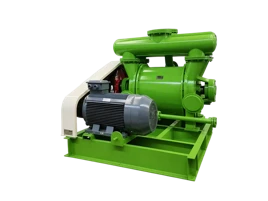
Single-stage cantilever design (2BE1 series): the workhorse for medium-to-large capacities in petrochemical and power plants, with one of the broadest frame ranges on the market;
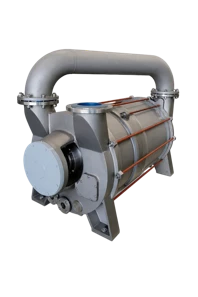
Two-stage design (2BED series): optimized for efficiency in the higher vacuum range;
Large units (2BE3 series): for very large capacities, supplied as complete systems with one-duty-one-standby arrangements or closed-loop circuits;
On speed: lower rotational speed generally means lower noise, slower wear and longer bearing life. Also confirm that inlet/outlet sizes match site piping, and that foundation loads and maintenance access are adequate.
10. Standards, Certification, Factory Testing and Documentation
For procurement teams, verifying the supplier's quality evidence chain is as important as the parameters themselves:
System and product certification: ISO 9001 quality, ISO 14001 environmental and ISO 45001 occupational health & safety management systems, plus CE marking for export;
Factory testing: insist on an as-tested performance report at your duty point (ultimate pressure, capacity, shaft power, noise, vibration). Reputable manufacturers test-run every pump before shipment - at Boke, every water ring pump undergoes an 8-hour continuous test run with all inspection records archived;
Documentation package: certificate of conformity, performance test report, installation & operation manual, spare parts list and a two-year spares recommendation;
Service capability: pre-sale support with sizing calculations and P&ID assistance, on-site commissioning, warranty terms and spare-parts lead time.
Appendix: Purchase Verification Checklist
Use this table directly as a technical annex to your RFQ and confirm each item with the supplier:
|
Item |
Key questions the supplier must answer |
|
Ultimate pressure |
Under which reference conditions? Full pressure-capacity curve available? |
|
Capacity at duty point |
Actual pumping speed at the required process pressure? Margin applied? |
|
Water temperature correction |
Performance loss at maximum summer water temperature (e.g. 30°C)? Compensation? |
|
Make-up water / closed loop |
Recommended make-up range? Can a closed-loop system be supplied? |
|
Shaft power & motor |
Shaft power at duty point? Motor efficiency class, Ex rating, voltage/frequency? |
|
Materials |
Material proposal for the medium (SS/duplex/titanium/Hastelloy)? |
|
Sealing |
Gland or mechanical seal? Double seal with buffer fluid available? Alternative working fluids? |
|
Cavitation protection |
Anti-cavitation valve, atmospheric ejector or two-stage option offered? |
|
Certification & testing |
ISO three-system + CE certification? Factory test report and test-run records? |
|
Documentation & service |
Content of documentation package? Sizing support, commissioning, spare parts availability? |
Conclusion
Selecting a water ring vacuum pump is, in essence, translating your process conditions accurately into technical parameters and matching them against the manufacturer's performance curves and system capability. Confirming the ten parameters above will prevent the vast majority of common field problems - vacuum falling short, summer trips and excessive energy consumption.
Shandong Boke Vacuum Technology Co., Ltd. founded in 2011, is a professional manufacturer of vacuum equipment with 150 employees (including 45 engineers and technicians) and 32 domestic patents. Our portfolio covers the complete 2BV, 2BE1, 2BE3 and 2BED water ring vacuum pump lines, liquid ring compressors, dry screw vacuum pumps, Roots pumps and complete vacuum systems, with customizable materials, sealing and closed-loop designs for your duty.
Send us your process data - working pressure, required capacity, gas composition, water temperature and power supply - and Boke's engineers will provide sizing calculations and a system proposal.
Contact: Shandong Boke Vacuum Technology Co., Ltd. | Tel: +86-533-4129899 | E-mail: vera@bokezhenkong.com | Web: www.bokevac.com