Two-Stage Liquid Ring Vacuum Pump: How It Works, Why It's Irreplaceable & vs Single-Stage + Air Ejector
In the 'medium vacuum' band of process industry (roughly 10-30 mbar), the two-stage liquid ring vacuum pump is a device that is both deep enough and robust enough. It pulls vacuum below what a single-stage pump can reach, yet handles wet gas, condensable vapor, and dirty media with ease-exactly why chemical, power, and pharmaceutical plants rely on it. This article follows the logic of 'what it is - why it appeared - customer needs - irreplaceability - comparisons - applications,' and answers a key question: can a single-stage liquid ring pump with an atmospheric ejector replace a two-stage pump?
1. What Is a Two-Stage Liquid Ring Vacuum Pump?
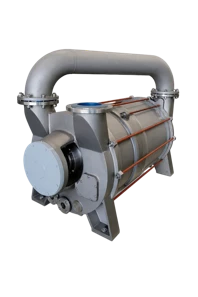
A liquid ring vacuum pump (also called a water ring vacuum pump when water is the sealant) is a rotary positive-displacement vacuum pump. Its core is a multi-bladed impeller mounted eccentrically inside a cylindrical casing partially filled with seal liquid (usually water, but oil, ethylene glycol, or any process-compatible liquid may be used). As the impeller rotates, centrifugal force throws the seal liquid against the casing wall, forming a rotating 'liquid ring.' The cavities between the blades and the ring expand and contract cyclically, performing suction-compression-discharge[4][5]. Because the rotor does not contact the casing, the liquid ring simultaneously provides sealing, compression, and heat absorption[4][6].
The difference between single- and two-stage lies in the number of compression stages: a single-stage pump compresses once in one chamber; a two-stage pump (usually two series impellers on a common shaft) sends gas pre-compressed by the first stage into a second stage for further compression[3][5]. From the early 1900s (Nash obtained US Patent 1,091,529 for liquid ring vacuum pumps and compressors in 1914, with roots in a 1903 Siemens-Schuckert patent in Germany)[11] to the later development of two-stage designs for deeper vacuum, the evolution extends the idea of 'replacing precision metal seals with a liquid ring'[1][3].
Two-stage gas path: process gas / condensable vapor -> first-stage impeller pre-compression -> inter-stage vapor condensation/separation -> second-stage impeller re-compression -> discharge + gas-liquid separator.
2. Why Did the Two-Stage Pump Appear?
The root cause is that a single-stage liquid ring pump's ultimate vacuum is limited by the saturated vapor pressure of the seal liquid. As the vacuum approaches the vapor pressure of the (usually water) seal liquid, the ring itself boils off heavily, pumping capacity collapses, and efficiency deteriorates[4][5][6]. With ambient-temperature water, a single-stage liquid ring pump typically reaches only about 30-50 mbar (approx 25-35 Torr)[1][4][5].
Many processes need vacuum below that limit-vacuum distillation and solvent recovery in chemical/petrochemical plants, and condenser air evacuation in power turbines[1][2][3]. These duties demand deeper vacuum yet involve large condensable-vapor loads, liquid carryover, and continuous operation, while dry pumps cannot tolerate wet/dirty media and steam ejectors consume huge amounts of steam and water[7][8]. So, within the same seal liquid and principle, 'two stages in series with a lower per-stage compression ratio' gets closer to the vapor-pressure limit and markedly improves high-vacuum efficiency-giving birth to the two-stage liquid ring pump[1][3][7]. Nash's TC and AT two-stage series were developed specifically for condenser air removal and chemical/petrochemical duties[1][2].
3. Where Are the Customer Needs?
Deeper vacuum: the 10-30 mbar band a single stage cannot reach (vacuum distillation, solvent stripping, high-vacuum condenser holding)[1][3][5].
Reliable condensable-vapor/solvent handling at high vacuum: the integral two-stage rotor condenses, recovers, or safely disposes of process vapor between stages[1][2][7].
High-vacuum efficiency: two-stage efficiency is about 35%-40% higher than single-stage at high vacuum, cutting power cost[6][7].
Continuous, reliable operation in harsh duty: tolerant of liquid carryover and load swings, low maintenance, suited to 24/7 service[1][2][10].
4. What Makes the Two-Stage Liquid Ring Pump Irreplaceable? (vs Other Technologies)
The two-stage liquid ring pump occupies a niche other vacuum technologies struggle to cover simultaneously: it operates stably in the ~10-30 mbar medium-vacuum band while tolerating wet gas, condensable vapor, liquid carryover, soft particles, and even flammable/explosive/corrosive gases[4][5][7][10]. Consider:
Dry screw/claw pumps reach deeper vacuum and save energy, but fail if they ingest liquid or solids, with costly repairs[7][8];
Steam/water-vapor ejectors handle vapor but consume large amounts of steam/water and need a high-level hotwell or barometric leg[3];
Oil-sealed vane pumps suffer lubricant contamination from condensable vapor[5];
Moreover, liquid ring compression is nearly isothermal-compression heat is absorbed by the circulating liquid-making it safer for flammable, explosive, or temperature-sensitive media[3][5][6]; and with water/compatible liquid as sealant, the compression chamber is oil-free, eliminating oil-vapor backstreaming for food, pharma, and electronics[4][5][6].
Combined, these traits make the two-stage liquid ring pump often irreplaceable where both moderate-depth vacuum and nasty media must be handled.
5. Its Irreplaceability vs the Single-Stage Pump
Single- and two-stage share the liquid ring principle and the same gas compatibility; the two-stage's value is in vacuum depth and efficiency:
|
Aspect |
Single-stage liquid ring |
Two-stage liquid ring |
|
Typical ultimate vacuum (ambient water) |
~30-50 mbar |
~10-30 mbar |
|
High-vacuum efficiency |
Pumping speed and efficiency collapse below ~20 kPa inlet |
~35%-40% higher efficiency than single-stage at high vacuum |
|
Inter-stage vapor condensation/recovery |
None |
Condenses and separates process vapor |
|
Vacuum band |
Rough / low vacuum |
Medium vacuum (deeper) |
|
Cost / complexity |
Low, simple |
Higher (two impellers / inter-stage) |
Sources: Nash, Busch, Kaiquan, Acme[1][3][6][7]. So when the process requires vacuum below the single-stage limit yet the medium remains wet/condensable/dirty, the two-stage is the only liquid-ring option that reaches that vacuum while keeping the inherent liquid-ring tolerance-its 'irreplaceability' versus single-stage. Conversely, for rough vacuum and budget-sensitive cases, the single-stage is simpler and cheaper and is not replaced by the two-stage[6][7].
6. Advantages vs Dry Vacuum Pumps
Against dry pumps (screw, claw, scroll), the two-stage liquid ring pump's core strengths are tolerance and safety for harsh media:
Tolerates wet gas, condensable vapor, and liquid carryover: the ring 'swallows' vapor, condenses it in place, and flushes away fine solids; dry pumps often trip or are damaged by droplets/particles[7][8].
Isothermal, inherently safe: suited to flammable/explosive gas with no high-temperature ignition risk; dry pump exhaust can exceed 400 F (~200 C), a safety concern[8][9].
Oil-free, clean compression chamber: meets requirements of food, pharma, electronics sensitive to oil vapor[4][5].
Simple, lower capital cost: dry pumps typically cost about 2x the liquid ring pump[9]; the liquid ring pump has only one rotating part and low maintenance[4][5].
The honest trade-off: the liquid ring pump needs continuous seal-liquid supply and treatment, typically ~20%-30% more power than a dry pump, and more water; dry pumps win on energy, water-free operation, and life (~15-20 yr vs 6-8 yr for liquid ring)[8][9]. Selection is essentially a 'media compatibility vs energy/water' trade-off[7][8].
7. Does It Handle Different Gases Than the Single-Stage Pump?
Essentially no. Which gases a liquid ring pump can handle depends on seal-liquid/process compatibility, not on the number of stages. Both single- and two-stage share the same principle and thus handle wet/saturated gas, condensable vapor, soft particles, corrosive, and flammable/explosive gases[4][5][10].
The difference is in the operating envelope, not gas type: thanks to series staging with inter-stage condensation/separation, the two-stage better exploits 'condensing vapor inside the pump, reducing gas volume to discharge' under deep-vacuum, high-vapor-load conditions, so it excels at solvent recovery and vacuum distillation with heavy vapor loads[1][2][3][7]. In short, the two-stage does not handle 'gases the single-stage cannot'; it stays stable where the single-stage would lose pumping speed and efficiency under deep vacuum with heavy vapor.
8. Two-Stage vs Single-Stage + Atmospheric Ejector: Features & Can It Replace?
An atmospheric ejector is based on the Venturi jet principle and is mounted on the suction side of the liquid ring pump (ejector outlet to pump inlet). The pump establishes vacuum at its own inlet; the ejector uses atmospheric air as the driving medium to pull a deeper vacuum at the inlet. The assembly consumes no power, has no moving parts, and can be retrofitted onto an existing single-stage pump[12][13]. With an atmospheric ejector, a single-stage liquid ring pump's ultimate vacuum typically extends to about 5-26 mbar-overlapping the two-stage band[12][13][14].
So, can a single-stage pump + atmospheric ejector replace a two-stage pump? Conclusion: it can replace the two-stage in a good share of medium-vacuum duties, but not completely.
|
Dimension |
Single-stage + atmospheric ejector |
Two-stage liquid ring |
|
Ultimate vacuum |
~5-26 mbar |
~10-30 mbar |
|
Power consumption |
Ejector uses no power (driven by atmosphere) |
Two impellers, slightly higher power |
|
Moving parts / maintenance |
Ejector is static, no moving parts |
Still single rotating part, low maintenance |
|
Air introduction |
Introduces atmospheric air (dilutes process gas) |
No external air, purer process gas |
|
Net speed / heavy vapor |
Part of capacity spent moving entrained air; lower efficiency under heavy vapor |
Inter-stage condensation; higher efficiency under heavy vapor |
|
Cost / retrofit |
Single-stage + simple ejector, low cost, retrofit possible |
Integrated two-stage, higher initial cost |
|
Best for |
General medium vacuum tolerating air dilution |
Solvent recovery, inert/explosive atmosphere, high net speed at depth |
Where it can replace: when the process tolerates air dilution, needs vacuum in the 5-26 mbar range, and wants deeper vacuum at lower cost (or as a retrofit of an existing single-stage pump), single-stage + atmospheric ejector is economical[12][13].
Where it cannot fully replace: 1) In solvent recovery, flammable/explosive, or inert-atmosphere duties where air ingress is unacceptable, the ejector's air introduction is a fatal flaw, and the two-stage-introducing no external gas-is preferable[12][13]; 2) For large condensable-vapor loads requiring high net pumping speed, the two-stage's inter-stage condensation and recovery is more efficient[1][3]; 3) When a single integrated, compact unit is wanted rather than a 'pump + ejector' combination, the two-stage is simpler to own.
In short: the atmospheric ejector is a low-cost 'air-for-vacuum' patch; the two-stage is an integrated solution 'born for deep vacuum and nasty media.' Selection hinges on whether the process can tolerate that introduced air[12][13].
9. Where Is It Applied?
|
Industry |
Typical use |
|
Chemical / Petrochemical |
Vacuum distillation, solvent recovery, absorption/stripping, corrosive/condensable gas handling |
|
Oil & Gas / Refining |
Crude vacuum distillation, dehydration, flare-gas recovery, vacuum column evacuation |
|
Power |
Turbine condenser air extraction (air ejector), condenser vacuum holding, startup evacuation |
|
Pharmaceutical |
Vacuum drying, solvent stripping, crystallization, evaporation |
|
Food & Beverage |
Vacuum evaporation/concentration, vacuum cooling, dehydration (large water vapor) |
|
Pulp & Paper |
Paper machine dewatering, couch/wire-section vacuum, formation improvement |
|
Mining & Metallurgy |
Slurry vacuum filtration, moisture-rich gas handling, mineral concentration |
|
Plastics & Rubber |
Polymer degassing, extruder volatile/monomer removal |
|
Environmental / Water |
Biogas extraction, vacuum filtration, off-gas treatment, soil remediation |
Compiled from Nash, Eurovacuum, CVS application data[1][2][10].
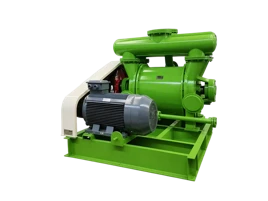
10. Why Choose Our 2BED Two-Stage Liquid Ring Vacuum Pump?
In duties of 'medium vacuum + wet/condensable/dirty/flammable-explosive media,' the two-stage liquid ring pump is often the only choice that is both deep enough and robust enough. Our 2BED series two-stage liquid ring vacuum pump is developed exactly for such needs: within the same liquid ring principle, two series stages deliver lower ultimate vacuum and higher high-vacuum efficiency, while inheriting all the liquid ring's strengths-liquid carryover tolerance, isothermal safety, oil-free operation, and simple construction. It suits vacuum distillation, solvent recovery, vacuum drying, and air-evacuation duties in chemical/petrochemical, power condensers, pharmaceutical, food, pulp & paper, and mining & metallurgy.
If you are weighing 'single-stage + atmospheric ejector' against 'two-stage': in solvent recovery, inert/explosive atmospheres, and heavy-vapor-load duties where air ingress is unacceptable, the 2BED two-stage pump is the safer choice-it introduces no external air (purer process gas) and keeps high net speed under heavy vapor via inter-stage condensation.
Learn more about the 2BED two-stage liquid ring vacuum pump
FAQ
Q: How deep a vacuum can a two-stage liquid ring pump reach?
A: With ambient water, a two-stage liquid ring pump typically reaches about 10-30 mbar ultimate vacuum-clearly deeper than a single-stage's 30-50 mbar[1][4][5]. With lower-vapor-pressure seal liquid (e.g., oil) or an ejector, it can go even deeper.
Q: Which is better: two-stage or single-stage + atmospheric ejector?
A: Not absolute. Single-stage + ejector is low-cost, power-free, and retrofittable, and can replace the two-stage in general medium-vacuum duties that tolerate air dilution; but for solvent recovery, inert/explosive atmospheres, and heavy vapor loads where air ingress is unacceptable, the two-stage is preferable[12][13].
Q: What seal liquids can a two-stage liquid ring pump use?
A: Water is most common; oil, ethylene glycol, or any process-compatible liquid may be used. Ultimate vacuum is limited by the seal liquid's vapor pressure; lowering seal-liquid temperature raises vacuum[4][5][6].
Q: How to choose between a two-stage liquid ring pump and a dry pump?
A: Choose liquid ring for wet/condensable/dirty/flammable-explosive media; choose dry for clean gas with energy/water-saving goals. It is essentially a 'media compatibility vs energy/water' trade-off[7][8][9].
Q: Which industries use two-stage liquid ring pumps?
A: Chemical/petrochemical, oil refining, power condensers, pharmaceutical, food & beverage, pulp & paper, mining & metallurgy, plastics & rubber, and environmental/water treatment[1][2][10].
Conclusion
If the duty is 'rough vacuum + clean gas,' a single-stage liquid ring or a dry pump suffices; for 'medium vacuum (10-30 mbar) + wet/condensable/dirty/flammable-explosive media,' the two-stage liquid ring pump is usually the most robust and least replaceable choice[1][3][7][8]. When pushing below a single-stage limit, compare 'single-stage + atmospheric ejector' (low cost, introduces air) with 'two-stage' (integrated, purer process gas); for air-sensitive or heavy-vapor duties, prefer the two-stage-such as our 2BED two-stage liquid ring vacuum pump.
References
[1] NASH. Liquid Ring Vacuum Pump Two Stage, AT. https://www.nashpumps.com/en-us/liquid-ring-vacuum-pumps/at-two-stage-pump
[2] NASH. Liquid Ring Vacuum Pump Two Stage, TC. https://www.nashpumps.cn/en/products-and-systems/liquid-ring-vacuum-pumps/two-stage-vacuum-pumps/tc-two-stage-pump/
[3] Busch Vacuum Pumps and Systems. Liquid Ring Vacuum Technology for the Chemical Industry (whitepaper). Chemical Engineering, 2018. https://www.chemengonline.com/wp-content/uploads/2018/06/buschllc-wp-jun2018.pdf
[4] University of Michigan Chemical Engineering Encyclopedia. Vacuum Pumps - Liquid Ring. https://encyclopedia.che.engin.umich.edu/vacuum-pumps/
[5] Saidesi. Liquid Ring Vacuum Pump: Working Principle, Applications & Selection Guide. https://saidesiaircompressor.com/liquid-ring-vacuum-pump/
[6] Kaiquan. KVDP Series Water Ring Vacuum Pump. http://www.kaiqpump.com/kvdp-series-water-ring-vacuum-pump/
[7] Acme Air Equipments. Two Stage Liquid Ring Vacuum Pump. https://www.acmeairequipments.com?p=173/
[8] Wintek Corporation. Vacuum Pumps (technology comparison). http://www.wintek-corp.com/vacuum-pumps/
[9] S4B Trade Ally. Dry Vacuum Pumps Save Water & Energy. https://www.s4btradeally.com/dry-vacuum-pumps-save-water-energy/
[10] Eurovacuum Products. Liquid Ring Pump (application fields). https://eurovacuumproducts.com/product/liquid-ring-pump/
[11] Wikipedia. Liquid-ring pump (background & patent history, tertiary source). https://en.wikipedia.org/wiki/Liquid-ring_pump
[12] Crystal TCS. Liquid Ring Pump Ejector. https://www.crystaltcs.com/liquid-ring-pump-ejector.php
[13] Taizhou Shouzhen Machinery (Souz Vacuum). Roots-Atmospheric Ejector-Liquid Ring Vacuum System in Pharmaceutical Equipment. http://m.souzvac.com/info/the-application-of-roots-air-injector-liqu-51803237.html
[14] Blower.cn. 2BV Series Liquid Ring Vacuum Pump and Compressor (with atmospheric ejector reaches 10 mbar). https://en.blower.cn/Products/Liquid-Ring-Vacuum-Pump/2BV-Series-Liquid-Ring.html