What Are the Temperature Limits of a High Volume Vacuum Pump?
When a vacuum pump is moving hundreds or thousands of cubic meters of gas every hour, temperature stops being a minor specification and becomes a design boundary. Thermal expansion changes internal clearances, heat degrades seals and lubricants, and in liquid ring pumps the temperature of the working fluid directly determines the deepest vacuum the pump can physically reach. Yet "temperature limits" is a phrase that means different things for different pump technologies - the limits of a liquid ring vacuum pump have very little in common with those of a dry screw vacuum pump or a Roots vacuum pump.
As a vacuum pump manufacturer producing high volume water ring pumps, dry screw pumps, Roots pumps and complete turnkey vacuum systems, we answer this question for customers almost every week. In this article, we break down the temperature limits of each technology in practical, engineering terms - what the numbers are, where they come from, and what happens if you ignore them.
First, Understand That "Temperature Limit" Actually Means Four Different Temperatures
Before comparing numbers, it helps to separate the four temperatures that govern any high volume vacuum pump:
Process gas inlet temperature - how hot the gas stream can be when it enters the pump suction.
Pump body and discharge temperature - how hot the pump internals and exhaust gas get during compression.
Sealing or working fluid temperature - critical for liquid ring pumps, where the seal water temperature defines the ultimate pressure.
Ambient and cooling water temperature - the environment and the cooling circuit that remove heat from the machine.
A pump does not have a single "maximum operating temperature." It has a thermal system, and each of these four temperatures has its own limit. When engineers at our factory review a customer's process data sheet, we check all four - and in most problem cases, the process is fine while the cooling water or seal fluid temperature has drifted out of range.
Temperature Limits of Liquid Ring (Water Ring) Vacuum Pumps
The liquid ring pump is the most temperature-sensitive of the three technologies, but not in the way most people expect. The pump itself is robust; the limitation comes from the physics of the sealing liquid.
The Working Fluid Is the Real Limit
A liquid ring vacuum pump compresses gas against a ring of service water (or another compatible liquid). At any given temperature, that liquid releases vapor into the pump chamber, and the pump can never pull a vacuum deeper than the saturated vapor pressure of its working fluid. In other words, the temperature of your seal water sets your ultimate pressure:
|
Water temperature |
Saturated vapor pressure (approx.) |
Practical effect |
|
10 °C |
~12 hPa |
Deepest vacuum, highest capacity |
|
15 °C |
~17 hPa |
Excellent performance |
|
25 °C |
~32 hPa |
Typical rated condition (e.g. 33 hPa class pumps) |
|
35 °C |
~56 hPa |
Noticeable capacity loss |
|
45 °C |
~95 hPa |
Severe loss of depth and pumping speed |
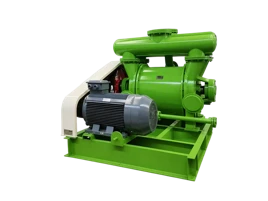
This is why high volume machines such as the 2BE1 and 2BE3 liquid ring vacuum pump series are rated at an ultimate pressure of 33 hPa - a figure that assumes moderate seal water temperature. If the sealing water gets hot, the rated vacuum simply is no longer achievable, regardless of how healthy the pump is.
Recommended Operating Windows
As a practical guide for industrial water ring pumps:
Working fluid (seal water) temperature: ideally 15–40 °C, with 15–25 °C being the sweet spot. Below about 10 °C performance improves but freezing protection and condensation issues appear in winter; above 40 °C, capacity and attainable vacuum degrade quickly.
Process gas inlet temperature: generally recommended to be kept below about 60 °C at the pump inlet. Hotter gas streams (common in distillation, drying and evaporation duties) are handled by installing a pre-condenser or by direct-contact cooling, so the pump sees a cooled, vapor-saturated stream rather than raw hot gas. With proper pre-condensing, liquid ring systems routinely serve processes whose upstream temperatures exceed 100 °C.
Discharge temperature: the exhaust gas leaves close to the working fluid temperature - one of the quiet advantages of this technology for handling flammable or condensable vapors.
Cavitation: The Failure Mode to Watch
When the pressure in the pump chamber approaches the vapor pressure of the working liquid, the liquid literally boils at the low-pressure zone and the vapor bubbles collapse violently downstream. The result is the classic "marble in a bucket" noise, vibration, erosion of the impeller, and a sudden collapse of pumping capacity. Cavitation is a temperature problem: hotter water, deeper target vacuum, and insufficient differential all push the pump toward it. A well-engineered system prevents it with correct seal water temperature, adequate flow, and - where the process demands very deep vacuum - a two-stage design such as the 2BED two-stage liquid ring pump or a Roots booster staged ahead of the liquid ring pump.
Temperature Limits of Dry Screw Vacuum Pumps
Dry screw vacuum pumps take the opposite approach: nothing is admitted into the pumping chamber except the process gas. There is no oil and no water to carry heat away, so thermal management is built into the pump architecture itself.
Where the Numbers Sit
For modern variable pitch dry screw pumps in industrial service:
Process gas inlet temperature: standard machines are generally offered for inlet gas up to about 60 °C, with many designs (including cooled and high-temperature variants) accepting 100 °C or more at the inlet when the gas has been appropriately treated upstream. For hotter streams, the gas should be pre-cooled, or the pump specified with a high-temperature configuration at the factory.
Pump body / discharge temperature: the screw pump relies on jacket cooling (and in some duties a nitrogen purge) to hold the pump body typically in the range of tens of degrees to roughly 100–120 °C. Because the variable pitch screw generates internal compression progressively along the rotor, the discharge temperature stays far lower than it would in a constant-pitch design - one of the main reasons variable pitch screw pumps such as our VDP dry screw vacuum pump series achieve both low energy consumption and tolerance of condensable vapors.
Ambient limit: most industrial dry screw pumps are rated for ambient temperatures of roughly 0–40 °C without derating; hot climates above 40 °C require attention to cooling circuit sizing and motor insulation class.
Why Screw Pumps Are Unforgiving of Over-Temperature
The rotors of a dry screw pump spin inside a stator with clearances measured in tenths of a millimeter. Those clearances are calculated for a specific thermal state. If the pump overheats - from excessive gas load, blocked cooling water, or a fouled cooler - the rotors expand toward the casing and toward each other. The sequence is predictable: rising discharge temperature, then noise, then rotor contact and seizure. This is why any well-instrumented screw pump package should include discharge temperature monitoring with alarm and trip setpoints, cooling water flow verification, and a gas ballast or purge strategy for condensable loads.
For aggressive or hot duties, materials matter as much as numbers: flow-path components in ductile iron with anti-corrosion coating, duplex stainless steel, or titanium extend the usable temperature and chemistry envelope considerably.
Temperature Limits of Roots Vacuum Pumps
The Roots pump is a booster, not a compressor in the conventional sense: its two figure-eight rotors move gas without internal compression. Compression happens abruptly at the discharge port, and - critically for this discussion - the temperature rise of the gas is proportional to the pressure difference the pump is forced to overcome. This single fact defines the thermal limits of the technology.
The Limits
Discharge temperature: conventional Roots vacuum pumps are typically limited to a discharge gas / pump body temperature of about 100 °C. Every datasheet expresses this indirectly as a maximum permissible differential pressure (for example, the ZJP Roots vacuum pump series specifies differential pressures in the 3,000–6,000 Pa class depending on model, enforced by a built-in bypass relief valve that protects the pump from overload).
Inlet gas temperature: typically up to about 60–100 °C, model-dependent, and contingent on the pump being correctly staged with its backing pump.
Starting discipline: a Roots pump started at atmospheric pressure against a large pressure differential will overheat within minutes. It must start only after the backing pump has pulled the system down to the pump's starting pressure - which is why interlocking the booster to the backing pump's pressure is standard practice in every system we build.
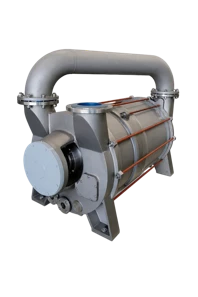
When the process demands high differential pressure or rough vacuum at very large flow, the answer is the gas circulation-cooled Roots pump (the ZJQ concept): a portion of the discharged gas is cooled in an external heat exchanger and returned through the pump body, absorbing compression heat. This allows the Roots principle - enormous pumping speed in a compact machine - to operate at pressure differences and temperatures a conventional Roots pump could never survive.
Temperature Management in Complete High Volume Vacuum Systems
In a turnkey high volume unit - say a Roots booster staged over a liquid ring pump, or a Roots–screw combination for a chemical plant - temperature is managed as a system property, not a pump property:
Closed-loop working fluid circuits with separator, plate heat exchanger and instrumentation hold the seal liquid in its ideal 15–35 °C window year-round, independent of season. Such circuits can also run alternative working fluids (methanol, ethanol, xylene, aniline, acetone, transformer oil) when the process requires it.
Interstage cooling between Roots stages and between booster and backing pump keeps each machine inside its own thermal envelope.
Pre-condensers knock out hot, condensable vapor before it reaches the pump, simultaneously reducing the gas load and cooling the stream.
Instrumentation and interlocks - discharge temperature sensors, cooling water flow and temperature switches, and motor winding protection - convert the limits above into an automatically protected machine.
A properly engineered skid is one where no single component ever sees a temperature its manufacturer did not design it for.
What Actually Happens When You Exceed the Limits
Each technology fails in its own characteristic way, and none of the failures are graceful at the extreme:
Liquid ring pumps: cavitation erodes the impeller and port areas; hot seal water destroys vacuum depth long before any metal is damaged. Capacity loss is the first symptom.
Dry screw pumps: thermal expansion consumes rotor clearances and ends in rotor-to-rotor or rotor-to-casing contact. Gear-end lubricant also oxidizes rapidly above its rated temperature - as a rule of thumb, every 10 °C of excess roughly halves the service life of oils and elastomers.
Roots pumps: rapid overheating at excessive differential pressure; rotor expansion leading to contact; degraded gear oil and, in sustained cases, distortion of the housing.
Quick Selection Guide by Process Temperature
|
Pump technology |
Typical inlet gas temperature |
Governing thermal constraint |
Naturally suited duties |
|
Liquid ring (2BV / 2BE1 / 2BE3 / 2BED) |
Up to ~60 °C direct; higher with pre-condensing |
Seal fluid 15–40 °C; vapor pressure sets ultimate vacuum |
Saturated vapors, condensables, flammable gas handling |
|
Dry screw (VDP variable pitch) |
~60 °C standard, up to ~100 °C+ in high-temperature configurations |
Body/discharge held below ~100–120 °C by jacket cooling |
Clean, dry or condensable processes; solvent recovery |
|
Roots booster (ZJP) |
~60–100 °C, model dependent |
Discharge ~100 °C max; differential pressure limit with relief valve |
Boosting a backing pump in deep vacuum systems |
|
Gas-cooled Roots (ZJQ) |
Higher, by design |
Internal gas circulation cooling |
High differential pressure, rough vacuum, huge flows |
Exact figures always depend on gas composition, materials of construction and cooling conditions - which is precisely why a factory review of your process conditions is worth doing before purchase.
Frequently Asked Questions
What is the maximum temperature a vacuum pump can handle? There is no single number. Standard industrial liquid ring pumps want gas at or below roughly 60 °C and seal water between 15–40 °C; dry screw pumps commonly accept 60–100 °C inlet gas depending on configuration; Roots pumps are limited by roughly 100 °C discharge temperature and their differential pressure rating. High-temperature variants of each technology extend these figures.
Can a water ring vacuum pump run with hot water? It can run, but it will not reach its rated vacuum. Because ultimate pressure is bounded by the vapor pressure of the water, every degree of seal water temperature costs vacuum depth. Above roughly 40 °C the effect is severe.
Why does my screw vacuum pump trip on high temperature? The usual causes are insufficient cooling water flow, a fouled heat exchanger, gas loads beyond design, or a process upset sending hot gas to the inlet. The trip itself did its job - it likely saved the rotors.
Does cold weather help vacuum pump performance? For liquid ring pumps, yes - colder seal water improves vacuum depth and capacity, down to the point where freezing and condensation management become the concerns. Screw and Roots pumps are largely indifferent to cold ambient but need correct lubricant viscosity.
Conclusion
The temperature limits of a high volume vacuum pump are not one number but a set of engineering boundaries - gas inlet temperature, body and discharge temperature, working fluid temperature, and cooling conditions - and each pump technology draws those boundaries differently. Liquid ring pumps are governed by their seal fluid, screw pumps by rotor clearances and jacket cooling, and Roots pumps by discharge temperature and differential pressure. Respecting these limits is what separates a vacuum system that runs for a decade from one that fails in its first summer.
As the manufacturer of the full range - from 2BV, 2BE1, 2BE3 and 2BED liquid ring pumps Through VDP variable pitch dry screw pumps to ZJP Roots boosters, ZJQ gas-cooled Roots pumps and complete engineered vacuum systems, Boke Vacuum designs every unit around the real temperatures of your process. If you are unsure whether your operating temperatures fit a given pump technology, send us your process conditions and our engineers will review them and propose the right configuration.
About Shandong Boke Vacuum Technology Co., Ltd. - established in 2011, a professional manufacturer of vacuum acquisition equipment: 2BV, 2BE1, 2BE3 and 2BED series liquid ring vacuum pumps and compressors, VDP series variable pitch dry screw vacuum pumps, ZJP and ZJQ series Roots vacuum pumps, and complete customized vacuum systems.
Web: www.bokevac.com | E-mail: vera@bokezhenkong.com | Tel: +86-533-4129899 | No.6 Huacheng Road, Yucheng Town, Boshan District, Zibo, Shandong, China