1. Required Vacuum Level (Ultimate Pressure)
Start with the process pressure you actually need, then decide how much margin you want above the pump's ultimate pressure.
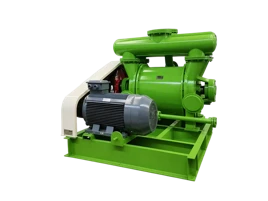
Rough vacuum duties, meaning paper machine dewatering, vacuum filtration, degassing and general chemical process work, usually operate at 33 to 80 hPa absolute or above. That range belongs to single-stage liquid ring pumps. The 2BE1 series from Shandong Boke Vacuum Technology, for instance, is rated at 33 hPa (a) ultimate pressure, with capacities from roughly 6.9 to 353 m³/min across the model range [2].
Ask for something deeper and you change equipment class. Vacuum distillation, freeze drying and most laboratory work need oil-sealed rotary vane pumps. Belt-driven two-stage vane pumps reach the 10⁻⁴ Torr class (approximately 10⁻⁴ mbar) [3].
Then there is margin, which is where catalogue numbers get misread. Pumping speed collapses as a mechanical pump approaches its ultimate pressure. If the pump's rating is barely below the process requirement, it delivers almost no net capacity at the working point, however good the catalogue figure looks. Vacuum technology practice is to select on the throughput required at the operating pressure. Free-air displacement, on its own, tells you very little [4, 5].
2. Pumping Speed and Capacity at the Operating Point
With the pressure fixed, size the pump on the pumping speed it actually delivers at that pressure, not on the free air displacement written on the nameplate. Start with the gas load:
Add up the gas load. Process off-gassing, air ingress through leakage, and the volume that has to be evacuated within the pump-down time you are being held to.
Read the manufacturer's performance curve at your operating pressure, not at atmospheric pressure. On positive-displacement pumps, volumetric efficiency drops as pressure drops.
Ask how the published numbers were measured. Check the stated performance against a recognized test standard and ask for the test reports. Boke states that each pump is tested in-house against relevant standards before shipment, with test reports and certificates supplied with every unit [2].
One trade-off belongs specifically to belt-driven rotary vane pumps. The belt lets the pump run slower than the motor, which is good for temperature and bearing life, but it also means less free air displacement from a given frame size than an equivalent direct-drive pump would give [3, 6]. Where pump-down time is the governing requirement, that gap has to be checked against the capacity you need before anything else is decided.
3. Gas Composition: Corrosive, Condensable, Flammable, and Dirty Gases
The gas dictates the pump. More than any other input, in fact; published selection guides generally put the process gas first [7].
Wet, condensable or corrosive streams are the traditional home of the liquid ring pump. Sour gas, vapors carrying acids or chlorides: the ring liquid absorbs the heat of compression continuously and washes or neutralizes contaminants on the way through. Boke's 2BE1 liquid ring pumps are rated for suction, compression and transport of flammable, explosive and corrosive gases, covering crude-oil vacuum distillation, degassing and flare gas recovery [2].
An oil-sealed rotary vane pump goes considerably deeper but is far more sensitive. Corrosive gas and particulate loading degrade both performance and service life; the published work on vane pumps in aggressive service is largely about managing that exposure through gas ballast, inert purge and correct oil selection [8]. Where the duty is dirty, corrosive and deep, the conversation is usually about the accessory package as much as about the pump.
Solids accelerate wear in any positive-displacement machine. If the gas carries particles, inlet separation and filtration belong in the system scope from the start. Someone will try to add them later as a spare-parts line item, and it will not work as well.
Flammable or explosive mixtures bring their own constraints: ATEX/Ex-rated motors, appropriate sealing, and some pump technologies ruled out outright.
On materials, establish what is standard and what is a costed option. Impeller (nodular iron or stainless), shaft sleeves, mechanical seals. On a liquid ring system, the working fluid's compatibility with the process comes under the same scrutiny. Closed-loop working-fluid systems, meaning separator plus heat exchanger, are specified more often now, partly to cut water consumption and partly to recover process solvents. Boke builds closed-loop systems able to circulate water, methanol, ethanol, xylene, aniline, acetone or transformer oil as the working fluid [2].
4. Drive Configuration, Speed Ratio, and Layout Flexibility
Here is where a belt driven pump stops being a direct-coupled pump with a belt bolted on.
The pulley ratio sets pump speed independently of motor speed:
Driven shaft speed (RPM) = motor speed (RPM) × (driver pulley diameter ÷ driven pulley diameter) [1]
That single relationship has consequences. A standard 2-pole, 4-pole or 6-pole motor can be matched to the pump's optimum speed instead of the other way around. Later, when the process duty changes, pulleys can be swapped to re-rate the pump and the motor stays. On the 2BE1 liquid ring series, rated pump speed varies widely by frame size: 1450 to 1750 r/min on small frames, down to about 210 to 330 r/min on the largest [2]. The drive has to land the pump inside its correct speed window, and on a belt drive that is a pulley calculation rather than a motor special order.
Belt drive also relaxes alignment. A coupling demands that motor and pump shafts be axially aligned to a tight tolerance; a belt does not, which simplifies skid design and saves space [1].
Procurement usually notices the motor point first. Because any standard motor will do, replacement motors are available locally, which matters for plants in remote locations and for export projects where lead time on a special motor is measured in months.
And belt drive is the wrong answer in some duties. Where you need maximum transmission efficiency, or where the machine must run with no scheduled drive maintenance at all, or where the atmosphere is extremely hot or heavily contaminated, or where torque is high and slip is unacceptable, look at direct coupling or a gear drive instead [1, 9].
5. Operating Speed, Wear, and Service Life
The engineering case for belt drive on a vacuum pump comes down to running the pump slower than the motor.
Welch, which has built belt-driven rotary vane pumps for a long time, states that they operate at roughly one-third the speed of comparable direct-drive models. Wear, operating temperature and oil degradation all fall with speed, which is the point of doing it [3]. Sanatron describes the same mechanism from the other side: lower RPM, lower temperature, less wear, longer life, in exchange for lower free-air displacement [6].
Translating that into purchasing language: slower pump speed generally means longer intervals between overhauls and less frequent oil changes on sealed pumps. That reduces lifetime maintenance cost. It does not reduce the purchase price, and the frame costs a little capacity in the trade. Buy on total cost of ownership rather than unit price; the vacuum engineering literature has made this argument for decades, because owning and operating cost outweigh the purchase price over the life of the equipment [5].
6. Transmission Efficiency and Energy Consumption
A belt drive is not loss-free. Even correctly installed, a V-belt loses power to friction and to the flexing of the belt as it wraps the pulleys; slip adds more on top. Direct drive transfers the same power with less loss [9]. That would be academic except that these are motor-driven machines, and electric motor-driven systems account for more than 40% of global electricity use [10]. On a process pump that runs continuously, that difference is a line item in the electricity bill.
What to do about it:
Size the pump so it runs near its best-efficiency point. An oversized belt-driven pump wastes energy continuously regardless of drive type. Published energy analyzes of liquid ring systems show that the pump working point and the system configuration, particularly separator temperature and the working-fluid loop, move specific energy consumption materially [11].
Specify matched multi-rib or banded V-belts, or timing belts where the process genuinely needs slip-free synchronized drive, and have them tensioned correctly at installation [1].
Ask the vendor for shaft power across the duty range, not just at one point. Reputable manufacturers publish shaft power and matched motor ratings per model. Boke's 2BE1 data tables list both for each frame and speed [2].
7. Maintenance Requirements and Overload Behavior
A belt drive changes the maintenance profile of the package, usually in the plant's favor. "Usually" carries weight here: the benefit only arrives if the routine is actually performed.
The routine is short. Belt tension gets checked, and re-checked after the run-in period on a new belt. Pulley alignment gets checked, because misalignment is a leading cause of premature belt wear. The belts themselves get looked at for cracking, glazing and fraying [1].
Tension has to be right in both directions, and it is worth being exact about it. Too loose and the belt slips, heats, and the pump loses speed, which shows up directly as a vacuum level that will not quite reach setpoint. Too tight and you overload the pump and motor bearings, which is a more expensive way to lose the same pump [1].
The belt does pay for its upkeep in one respect. Under a jam or a severe overload it slips or goes first, which makes it a crude mechanical fuse protecting the costlier machinery behind it [1].
Two items to confirm on the datasheet rather than assume. Belt side-load puts a radial load on the pump shaft, so the bearing arrangement has to be designed for belt drive duty. Ask whether heavy-duty or imported bearings are fitted. In exchange, the belt damps shock loads and torsional vibration between motor and pump, protecting both machines and reducing structure-borne noise [1].
On oil-sealed rotary vane pumps, budget for oil and filter changes as a running cost, not an exception. Condition monitoring studies on both rotary vane and liquid ring pumps find that oil condition, vibration and temperature trends give warning well before failure [12, 13]. The value is only realised if somebody logs them.
8. Installation Environment
The site decides whether a belt drive is viable at all.
Belts dislike their environment. Extreme heat or cold, high humidity, salt, oil mist and corrosive atmospheres all attack the belt and shorten its service life; direct-drive or enclosed designs tolerate harsh surroundings better [9]. If the pump is going into a chemical shed or on an outdoor skid in a coastal plant, that answer is settled before performance is discussed.
Cooling is the other hard constraint. Liquid ring pumps reject process heat through the ring liquid, so the working-fluid loop, meaning separator, heat exchanger and cooling water, has to be engineered against the site's worst-case cooling-water temperature. Ring-liquid temperature determines the attainable suction pressure directly [4, 11], which is why the worst-case water temperature, not the average, is the number to design against.
Space and access: belt-driven packages need clearance to take the guard off, change a belt, and get a tension gauge in. Check the skid dimensions and the lifting provisions against the footprint you actually have, and leave room for a tension gauge.
Safety: drive guards are mandatory. Confirm the package complies with the machinery directives that apply to the destination market. CE marking is the norm for equipment sold into Europe; Boke's 2BE1 pumps carry CE certification, and the company holds ISO 9001, ISO 14001 and ISO 45001 certificates [2].
Foundation and alignment: belts forgive more misalignment than couplings do, but the pump and motor still sit on a baseplate that must be level and rigid. Saving money on the baseplate is a false economy once the machine is running.
9. Noise, Vibration, and Cleanliness Requirements
Belt drives run quieter than gear-type transmissions and damp torsional vibration [1], and the reduced pump speed takes noise down again. For an indoor installation with people nearby, that's usually decisive on its own.
Oil-sealed pumps return oil mist at the exhaust unless a mist eliminator and muffler are fitted. In a clean room, or a food or pharmaceutical hall, untreated exhaust is not acceptable, so the eliminator belongs in the initial scope and cost.
Where contamination cannot be tolerated at all, semiconductor and much of pharma, ask a harder question than which belt to fit: whether an oil-sealed pump should be used at all. Dry pumps (screw, claw, diaphragm) exist for exactly this, and the criteria for choosing between oil-sealed and oil-free pumping are well covered in the vacuum literature [7].
10. Supplier Capability, Documentation, and Standards Compliance
The last factor is the vendor, and it belongs in the technical decision rather than the commercial one.
Does the supplier size the pump against your duty point, meaning pressure, capacity, gas composition and cooling-water temperature, or do they sell you a frame size and hope? The difference shows up in whether the offer includes a performance curve for your conditions.
Insist on factory test reports, product certificates and manuals. Reputable suppliers ship this documentation with every pump [2]; a supplier who treats it as an extra is telling you something about their process.
Check the certifications the installation actually requires - CE for machinery, ISO 9001 for quality, ISO 14001 environmental, ISO 45001 occupational health and safety, plus whatever the sector itself demands [2].
Spare parts decide how long the machine stays in service. A belt-driven package depends on belts, pulleys, bearing kits, seal kits and vanes staying obtainable for as long as the machine is in service. Ask for a recommended two-year spares list at order time and confirm commissioning and after-sales terms while the negotiation is still open.
Process vacuum is application-specific. Confirm with the supplier that they can adapt the supplier can adapt materials, sealing, working-fluid loop design (open or closed circuit) and drive configuration to your conditions rather than only to their standard range [2].
Quick Comparison: Belt Drive vs. Direct Drive for Vacuum Pumps
|
Aspect |
Belt driven |
Direct coupled |
|
Pump speed control |
Independent of motor speed, set by pulley ratio |
Equals motor speed |
|
Pump speed (typical) |
Lower. On vane pumps, roughly 1/3 of a direct-drive equivalent [3] |
Higher |
|
Wear, temperature, oil life |
Lower temperature and less wear; oil degrades more slowly [3, 6] |
Higher thermal and wear load |
|
Free-air displacement |
Lower for the same pump frame [6] |
Higher |
|
Transmission efficiency |
Losses from friction, belt flexing and slip [9] |
Higher |
|
Overload behavior |
Belt slips or breaks first, acting as a mechanical fuse [1] |
Torque transmitted directly |
|
Maintenance |
Belt tension and alignment checks, periodic belt replacement [1] |
Fewer drivetrain items |
|
Environment sensitivity |
Sensitive to heat, oil, dust, corrosive atmospheres [9] |
More tolerant |
|
Motor flexibility |
Any standard motor; re-ratable later by changing pulleys [1] |
Motor tied to pump speed |
Selection Checklist (Summary)
Define the required operating pressure and the margin above ultimate pressure.
Calculate required pumping speed at the operating point and request performance curves.
Characterize the gas. Corrosive? Condensable? Flammable? Dust-laden?
Confirm pump principle (liquid ring, oil-sealed vane, or dry) and materials of construction.
Verify drive layout: pulley ratio, pump speed window, guard, and access for belt changes.
Review energy: shaft power at the duty point, drive losses, cooling and working-fluid loop design.
Write down the maintenance regime before ordering: tensioning, alignment, belts, oil, seals.
Check environmental limits: ambient temperature, humidity, contaminants.
Confirm certifications, factory test reports and the documentation package.
Evaluate supplier engineering support, spares availability and total cost of ownership.
Conclusion
Belt drive earns its place in the rough to medium vacuum range, where the plant can use a pump running slower than its motor, and where a standard motor or a flexible layout matters at the site. The price of that is some free-air displacement, some transmission efficiency, and a maintenance routine that somebody has to actually carry out.
None of it substitutes for process data: the pressure and capacity required, what the gas is made of, what the site is like, what the cooling water does in summer, and what a running hour costs over the life of the machine. Everything else in the specification follows from those.
If you are specifying a liquid ring or dry vacuum system, Boke Vacuum's engineers can review your operating conditions and propose a pump and drive configuration matched to your process. Learn more at www.bokevac.com.
FAQ
Q: What is the main advantage of a belt driven vacuum pump over a direct-drive one? A: The pump turns slower than the motor. Lower speed means less wear, lower operating temperature and slower oil degradation, so the pump lasts longer [3, 6]. The belt also damps vibration, and it gives way under an overload before the pump does [1].
Q: What is the main disadvantage? A: Two things. For the same frame size you get lower free-air displacement than a direct-drive pump [6], and the belt costs you some transmission efficiency [9].
Q: Can I change the pump speed later? A: Yes. Change the pulley diameters and the pump-to-motor ratio changes with them. The motor stays where it is [1].
Q: How often should belts be checked? A: Follow the manufacturer's schedule. The minimum that makes sense is a re-tension after the run-in period on a new belt, then periodic inspection of tension, alignment and belt condition for cracks, glazing and fraying [1].
Q: Which pump type suits corrosive or condensable process gases? A: Liquid ring pumps, generally. The ring liquid handles the heat of compression and washes the contaminants out, and they take flammable gas in their stride. An oil-sealed vane pump can do the duty too, but only with protection fitted: gas ballast, filtration, and the right oil [2, 8].
References
[1] Shandong NDS Mechanical Equipment Co., Ltd., "A Practical Guide to Belt Drive Systems for Generators and Vacuum Pumps," nds-beltpulley.com. https://nds-beltpulley.com/a-practical-guide-to-belt-drive-systems-for-generators-and-vacuum-pumps/
[2] Shandong Boke Vacuum Technology Co., Ltd., "2BE1 Liquid Ring Vacuum Pump," www.bokevac.com. https://www.bokevac.com/liquid-ring-vacuum-pump/2be1-liquid-ring-vacuum-pump.html (see also company overview at https://www.bokevac.com/)
[3] Welch Vacuum (Ingersoll Rand), "Belt-Driven Rotary Vane Pumps." https://www.welchvacuum.com/en-nam/vacuum-pumps/belt-driven-pumps/
[4] D. M. Hoffman, B. Singh, J. H. Thomas III, Handbook of Vacuum Science and Technology, Academic Press/Elsevier, 1998. DOI: 10.1016/B978-0-12-352065-4.X5040-8
[5] J. F. O'Hanlon, A User's Guide to Vacuum Technology (covers the understanding, selection, and operation of vacuum equipment, including the economics of purchasing, owning, and operating vacuum systems).
[6] Sanatron LLC, "Belt Drive Rotary Vane Vacuum Pumps." https://www.sanatron.com/belt-drive-rotary-vane-vacuum-pumps.php
[7] P. Duval, "Selection criteria for oil-free vacuum pumps," Journal of Vacuum Science & Technology A 7, 2379 (1989). DOI: 10.1116/1.575901
[8] F. J. Eckle, P. Bickert, R. Lachenmann, "Rotary vane and roots pumps backed by diaphragm pumps - progress in corrosive applications and clean vacuum requirements," Vacuum 46 (1995). DOI: 10.1016/0042-207X(95)00041-0
[9] Fluid-Aire Dynamics, "Direct-Drive vs. Belt-Drive Air Compressors: What's Better?" (drive efficiency, environment sensitivity, and maintenance comparisons applicable to belt-driven machinery). https://fluidairedynamics.com/blogs/articles/direct-drive-or-belt-driven-air-compressor-what-s-better
[10] P. Waide, C. U. Brunner, "Energy-Efficiency Policy Opportunities for Electric Motor-Driven Systems," IEA Energy Papers, OECD/IEA, 2011. DOI: 10.1787/5kgg52gb9gjd-en
[11] R. Miladi, N. Frikha, S. Gabsi, "Modeling and energy analysis of a solar thermal vacuum membrane distillation coupled with a liquid ring vacuum pump," Renewable Energy 148 (2020). DOI: 10.1016/j.renene.2020.10.136
[12] G. Q. Qiu, S. Huang, L. L. Zhu et al., "Performance Monitoring Analysis of Liquid Ring Vacuum Pumps," Applied Mechanics and Materials 853 (2016). DOI: 10.4028/www.scientific.net/AMM.853.463
[13] P. Łój, W. Cholewa, "Diagnostics of Rotary Vane Vacuum Pumps Using Signal Processing, Analysis and Clustering Methods," in Studies in Systems, Decision and Control, Springer, 2020. DOI: 10.1007/978-3-030-58964-6_8