Hey there! As a supplier of large vacuum pumps, I often get asked about the ability of these pumps to handle condensable gases. It's a crucial topic, especially for industries where condensable gases are a common part of the process. So, let's dive right in and explore this aspect in detail.
First off, what are condensable gases? Well, these are gases that can change from a gaseous state to a liquid state under certain conditions, usually when the temperature drops or the pressure increases. Examples of condensable gases include water vapor, ethanol vapor, and refrigerant gases. In industrial processes, dealing with condensable gases can be a bit tricky, as they can cause issues like corrosion, reduced pump efficiency, and even damage to the pump itself.
So, how well can a large vacuum pump handle these condensable gases? The answer depends on several factors, including the type of vacuum pump, its design, and the specific operating conditions.
Let's start with the type of vacuum pump. There are several types of large vacuum pumps available in the market, such as liquid ring vacuum pumps, rotary vane pumps, and dry screw pumps. Each type has its own advantages and limitations when it comes to handling condensable gases.
Liquid ring vacuum pumps are a popular choice for handling condensable gases. They work by using a liquid (usually water) to create a seal and transfer energy. The liquid also helps to cool the pump and condense the condensable gases. One of the main advantages of liquid ring vacuum pumps is their ability to handle large amounts of condensable gases without getting damaged. They can also operate at relatively low pressures, making them suitable for a wide range of applications.
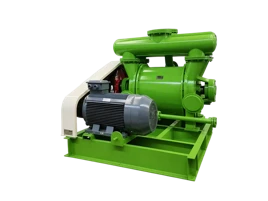
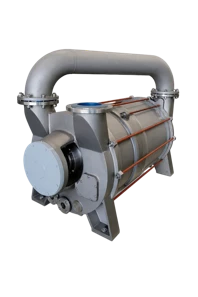
For example, our 2BE3 Large Liquid Ring Vacuum Pump is designed to handle high volumes of condensable gases. It has a robust construction and a large liquid ring, which allows it to handle large amounts of vapor without losing efficiency. The pump is also equipped with a separator, which helps to remove the condensed liquid from the gas stream, preventing it from re - entering the pump and causing damage.
Another type of liquid ring vacuum pump we offer is the 2BV Liquid Ring Vacuum Pump. This pump is more compact and is suitable for smaller applications where space is limited. It still has a good ability to handle condensable gases, thanks to its well - designed liquid ring system.
The 2BE1 Liquid Ring Vacuum Pump is also a great option. It combines high performance with reliability and is capable of handling a significant amount of condensable gases. It has a simple design, which makes it easy to maintain and operate.
On the other hand, rotary vane pumps are less suitable for handling large amounts of condensable gases. These pumps work by using rotating vanes to create a vacuum. Condensable gases can cause the vanes to stick or wear out quickly, reducing the pump's efficiency and lifespan. However, if the amount of condensable gas is relatively small, and proper pre - treatment (such as using a condenser) is applied, rotary vane pumps can still be used.
Dry screw pumps are another option. They are oil - free and can handle a certain amount of condensable gases. The screw design helps to compress the gas and can also handle some liquid carry - over. However, if the amount of condensable gas is too high, it can lead to issues like corrosion and clogging of the screw threads.
Now, let's talk about the design factors that affect a vacuum pump's ability to handle condensable gases. The size of the pump is an important factor. A larger pump generally has a greater capacity to handle condensable gases. This is because it has a larger internal volume and can accommodate more vapor before reaching its limit.
The material of construction is also crucial. For example, if the pump is going to be exposed to corrosive condensable gases, it should be made of a corrosion - resistant material, such as stainless steel or coated with a protective layer.
The operating conditions also play a significant role. The temperature and pressure of the gas stream can affect the condensation process. If the temperature is too high, the condensable gases may not condense properly, and if the pressure is too low, the pump may not be able to handle the gas effectively.
In addition, the flow rate of the gas stream is important. A high flow rate can increase the amount of condensable gas entering the pump, which may require a larger or more powerful pump to handle.
To ensure the best performance of a vacuum pump when handling condensable gases, some pre - treatment steps can be taken. For example, using a condenser before the pump can help to remove a large portion of the condensable gases. A separator can also be used to separate the condensed liquid from the gas stream.


In conclusion, the ability of a large vacuum pump to handle condensable gases depends on many factors. Liquid ring vacuum pumps are generally a good choice for handling large amounts of condensable gases, thanks to their design and the use of a liquid seal. Our 2BE3 Large Liquid Ring Vacuum Pump, 2BV Liquid Ring Vacuum Pump, and 2BE1 Liquid Ring Vacuum Pump are all excellent options for various applications involving condensable gases.
If you're in the market for a large vacuum pump to handle condensable gases, we'd love to have a chat with you. We can help you choose the right pump based on your specific requirements and operating conditions. Whether you're in the chemical industry, food processing, or any other field where condensable gases are a concern, we've got the solutions for you. So, don't hesitate to reach out and start a conversation about your vacuum pump needs.
References
- Perry, R. H., & Green, D. W. (1997). Perry's Chemical Engineers' Handbook. McGraw - Hill.
- Faires, V. M. (1965). Design of Machine Elements. Macmillan.