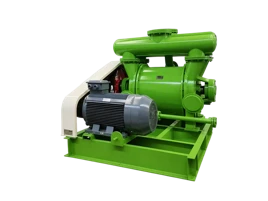
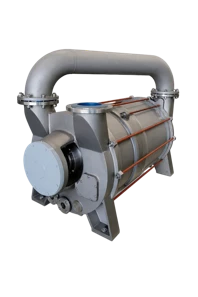
As a supplier of heavy-duty vacuum pumps, I often encounter customers who are confused about the differences between single-stage and two-stage heavy-duty vacuum pumps. In this blog post, I will delve into the key distinctions between these two types of pumps, helping you make an informed decision for your specific industrial needs.


Working Principle
Let's start with the fundamental working principles of single-stage and two-stage heavy-duty vacuum pumps. A single-stage vacuum pump operates on a relatively straightforward mechanism. It consists of a single pumping chamber where the air or gas is drawn in through an inlet port. Inside the chamber, a rotating impeller or a reciprocating piston creates a low-pressure area, causing the gas to enter. As the impeller rotates or the piston moves, the gas is compressed and then expelled through an outlet port.
On the other hand, a two-stage heavy-duty vacuum pump has two pumping chambers connected in series. The first chamber, also known as the roughing stage, operates in a similar way to a single-stage pump. It draws in the gas and compresses it to a certain intermediate pressure. Then, the partially compressed gas is transferred to the second chamber, the high-vacuum stage. In this stage, the gas undergoes further compression to achieve a much lower pressure. This two-step process allows the two-stage pump to reach deeper vacuum levels compared to a single-stage pump.
Vacuum Level
One of the most significant differences between single-stage and two-stage heavy-duty vacuum pumps lies in the achievable vacuum level. Single-stage pumps are typically designed for applications that require relatively moderate vacuum levels. They can generally reach a vacuum of around 10 to 100 millibar (mbar). This makes them suitable for tasks such as basic material handling, packaging, and some light industrial processes where a less extreme vacuum is sufficient.
In contrast, two-stage pumps are capable of reaching much deeper vacuum levels. They can achieve vacuums in the range of 0.1 to 1 mbar or even lower in some high-performance models. This makes them ideal for applications that demand a high degree of vacuum, such as vacuum distillation, freeze drying, and semiconductor manufacturing. For example, in semiconductor manufacturing, a precise and deep vacuum is crucial to prevent contamination and ensure the quality of the microchips being produced.
Pumping Speed
Pumping speed is another important factor to consider when comparing single-stage and two-stage heavy-duty vacuum pumps. Pumping speed refers to the volume of gas that a pump can remove from a system per unit of time, usually measured in liters per second (L/s) or cubic feet per minute (CFM).
Single-stage pumps generally have a higher pumping speed at moderate vacuum levels. They can quickly evacuate large volumes of gas when the pressure is relatively high. This makes them efficient for applications where a large amount of gas needs to be removed rapidly at the beginning of the process. However, as the vacuum level increases, the pumping speed of a single-stage pump tends to decrease significantly.
Two-stage pumps, on the other hand, maintain a relatively stable pumping speed over a wider range of vacuum levels. Although their initial pumping speed may be slightly lower than that of single-stage pumps at high pressures, they can continue to pump gas effectively as the vacuum deepens. This makes them more suitable for applications that require continuous and efficient pumping at low pressures.
Energy Efficiency
Energy efficiency is a crucial consideration for any industrial equipment, and vacuum pumps are no exception. Single-stage pumps are generally more energy-efficient at moderate vacuum levels. Since they have a simpler design and fewer components, they consume less power when operating at relatively high pressures. This can result in lower energy costs for applications that do not require a deep vacuum.
However, for applications that demand a deep vacuum, two-stage pumps can be more energy-efficient in the long run. Although they may consume more power initially, their ability to reach deeper vacuum levels more quickly and maintain a stable pumping speed can reduce the overall processing time. This can lead to energy savings over the course of a production cycle.
Applications
The differences in vacuum level, pumping speed, and energy efficiency between single-stage and two-stage heavy-duty vacuum pumps make them suitable for different applications.
Single-stage pumps are commonly used in industries such as food and beverage, packaging, and woodworking. In the food and beverage industry, they are used for vacuum packaging to extend the shelf life of products. In woodworking, they are used for holding workpieces in place during machining operations.
Two-stage pumps, on the other hand, are widely used in high-tech industries such as pharmaceuticals, electronics, and aerospace. In the pharmaceutical industry, they are used for vacuum drying and distillation processes to produce high-quality drugs. In the electronics industry, they are essential for semiconductor manufacturing and thin-film deposition.
Our Product Offerings
As a supplier of heavy-duty vacuum pumps, we offer a wide range of single-stage and two-stage pumps to meet the diverse needs of our customers. Our 2BED 2 Stage Liquid Ring Vacuum Pump is a high-performance two-stage pump that is suitable for applications requiring a deep vacuum. It features a robust design and advanced technology to ensure reliable operation and long service life.
We also have the 2BE1 Liquid Ring Vacuum Pump, which is a single-stage pump known for its high pumping speed and energy efficiency. It is ideal for applications that require rapid evacuation of large volumes of gas at moderate vacuum levels.
For larger industrial applications, our 2BE3 Large Liquid Ring Vacuum Pump offers a combination of high pumping speed and deep vacuum capabilities. It is designed to handle the most demanding industrial processes with ease.
Conclusion
In summary, the choice between a single-stage and a two-stage heavy-duty vacuum pump depends on several factors, including the required vacuum level, pumping speed, energy efficiency, and the specific application. Single-stage pumps are suitable for applications that require moderate vacuum levels and high initial pumping speed, while two-stage pumps are better for applications that demand deep vacuum levels and stable pumping performance at low pressures.
If you are unsure which type of pump is right for your application, our team of experts is here to help. We can provide you with detailed technical advice and recommend the most suitable pump for your needs. Contact us today to discuss your requirements and explore our range of heavy-duty vacuum pumps.
References
- ASHRAE Handbook - Refrigeration. American Society of Heating, Refrigerating and Air-Conditioning Engineers.
- Vacuum Technology Handbook. Leybold Vacuum.