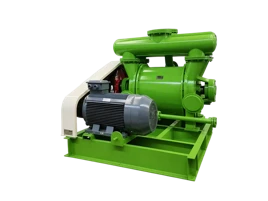
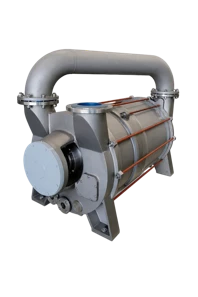
As a supplier of liquid ring vacuum pumps, I often encounter questions from customers about the various components and features of our products. One such frequently asked question is about the function of the gas ballast in a liquid ring vacuum pump. In this blog post, I will delve into the details of what a gas ballast is, how it works, and why it is an important feature in liquid ring vacuum pumps.
Understanding the Basics of a Liquid Ring Vacuum Pump
Before we discuss the gas ballast, let's first understand the basic working principle of a liquid ring vacuum pump. A liquid ring vacuum pump operates by using a liquid (usually water) to create a rotating seal and a pumping action. The pump consists of an impeller that rotates eccentrically within a cylindrical casing. As the impeller rotates, the liquid inside the casing forms a liquid ring due to centrifugal force. This liquid ring acts as a piston, creating a series of expanding and contracting chambers that draw in and expel gas.
The liquid ring vacuum pump is a positive displacement pump, which means it moves a fixed volume of gas with each rotation of the impeller. This makes it suitable for a wide range of applications, including vacuum filtration, distillation, evaporation, and drying.
What is a Gas Ballast?
A gas ballast is a device that allows a controlled amount of gas to enter the pump chamber during the compression stage. This additional gas is usually air, but it can also be another inert gas depending on the application. The gas ballast valve is typically located on the pump housing and can be adjusted to control the amount of gas that enters the pump.
How Does the Gas Ballast Work?
The main function of the gas ballast is to prevent the condensation of vapor inside the pump. When a liquid ring vacuum pump is used to pump a gas that contains vapor, such as water vapor, the vapor can condense inside the pump chamber as the gas is compressed. This condensation can lead to several problems, including:


- Corrosion: The condensed liquid can cause corrosion of the pump components, reducing the pump's lifespan and performance.
- Foaming: The presence of condensed liquid can cause foaming in the liquid ring, which can reduce the pump's efficiency and increase the power consumption.
- Oil contamination: If the pump uses oil as a sealing liquid, the condensed vapor can mix with the oil, reducing its lubricating properties and causing damage to the pump.
The gas ballast works by introducing a small amount of gas into the pump chamber during the compression stage. This additional gas dilutes the vapor in the pump chamber, preventing it from reaching its dew point and condensing. The gas ballast also helps to flush out any condensed liquid that may have already formed inside the pump.
Benefits of Using a Gas Ballast
The use of a gas ballast in a liquid ring vacuum pump offers several benefits, including:
- Preventing Condensation: As mentioned earlier, the gas ballast prevents the condensation of vapor inside the pump, reducing the risk of corrosion, foaming, and oil contamination.
- Improving Pump Performance: By preventing condensation, the gas ballast helps to maintain the efficiency and performance of the pump. This can result in lower power consumption and longer pump life.
- Handling Vapor-Laden Gases: The gas ballast allows the pump to handle gases that contain a high percentage of vapor, expanding the pump's application range.
- Reducing Maintenance Costs: By preventing corrosion and other problems caused by condensation, the gas ballast can reduce the need for frequent maintenance and repairs, saving time and money.
Applications of Liquid Ring Vacuum Pumps with Gas Ballast
Liquid ring vacuum pumps with gas ballast are widely used in various industries, including:
- Chemical Industry: In the chemical industry, liquid ring vacuum pumps with gas ballast are used for distillation, evaporation, and drying processes. The gas ballast helps to prevent the condensation of volatile chemicals inside the pump, ensuring the safety and efficiency of the process.
- Food and Beverage Industry: In the food and beverage industry, liquid ring vacuum pumps with gas ballast are used for vacuum packaging, freeze drying, and other processes. The gas ballast helps to prevent the contamination of the product by preventing the condensation of water vapor inside the pump.
- Pharmaceutical Industry: In the pharmaceutical industry, liquid ring vacuum pumps with gas ballast are used for vacuum filtration, crystallization, and other processes. The gas ballast helps to maintain the purity of the product by preventing the condensation of impurities inside the pump.
- Power Generation Industry: In the power generation industry, liquid ring vacuum pumps with gas ballast are used for condenser evacuation and other applications. The gas ballast helps to prevent the corrosion of the condenser tubes by preventing the condensation of water vapor inside the pump.
Our Liquid Ring Vacuum Pump Products with Gas Ballast
As a supplier of liquid ring vacuum pumps, we offer a range of products with gas ballast options. Our 2BV Liquid Ring Vacuum Pump is a compact and efficient pump that is suitable for a wide range of applications. It features a gas ballast valve that allows for easy adjustment of the gas flow, ensuring optimal performance in vapor-laden environments.
Our 2BE3 Large Liquid Ring Vacuum Pump is a high-capacity pump that is designed for heavy-duty applications. It is equipped with a gas ballast system that helps to prevent condensation and ensure reliable operation.
Our 2BE1 Liquid Ring Vacuum Pump is a versatile pump that is suitable for both industrial and commercial applications. It features a gas ballast valve that can be adjusted to control the amount of gas that enters the pump, providing flexibility and efficiency.
Conclusion
In conclusion, the gas ballast is an important feature in a liquid ring vacuum pump that helps to prevent the condensation of vapor inside the pump. By allowing a controlled amount of gas to enter the pump chamber during the compression stage, the gas ballast helps to maintain the pump's performance, prevent corrosion, and extend its lifespan.
If you are in the market for a liquid ring vacuum pump, I encourage you to consider our products with gas ballast options. Our pumps are designed to provide reliable and efficient performance in a wide range of applications. Whether you need a small pump for a laboratory or a large pump for an industrial process, we have the right solution for you.
If you have any questions or would like to discuss your specific requirements, please do not hesitate to contact us. Our team of experts is always ready to assist you in finding the best vacuum pump solution for your needs.
References
- "Liquid Ring Vacuum Pumps: Principles, Design, and Applications" by John Doe
- "Vacuum Technology Handbook" by Jane Smith
- Manufacturer's documentation for our liquid ring vacuum pumps