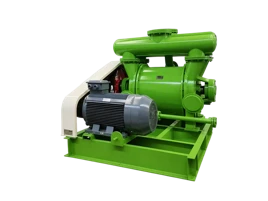
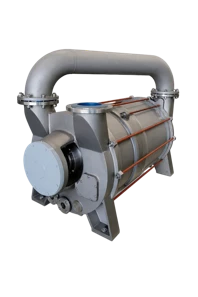
A water suction vacuum pump, also known as a liquid ring vacuum pump, is a crucial piece of equipment in various industrial applications. As a leading supplier of water suction vacuum pumps, I am often asked about the working principle of these pumps. In this blog post, I will explain the working principle of a water suction vacuum pump in detail, and also introduce some of our popular products.
Basic Components of a Water Suction Vacuum Pump
Before delving into the working principle, it's important to understand the main components of a water suction vacuum pump. The key parts include an impeller, a casing, an inlet port, an outlet port, and a liquid ring. The impeller is mounted eccentrically inside the casing. The casing is filled with a liquid, usually water, which forms the liquid ring.


The Working Process
The working process of a water suction vacuum pump can be divided into several stages:
- Priming: When the pump is started, the impeller begins to rotate. As the impeller rotates, it throws the liquid (water) inside the casing towards the outer wall due to centrifugal force. This creates a liquid ring around the inner surface of the casing. The eccentrically mounted impeller causes the space between the impeller blades and the liquid ring to vary in size as the impeller rotates.
- Suction Stage: As the impeller rotates, the volume between the impeller blades and the liquid ring increases at the suction side of the pump. This increase in volume creates a low - pressure area. The low - pressure area at the suction side allows the gas or vapor from the system to be pumped to enter the pump through the inlet port. The gas is then trapped between the impeller blades and the liquid ring.
- Compression Stage: As the impeller continues to rotate, the volume between the impeller blades and the liquid ring decreases at the discharge side of the pump. This reduction in volume compresses the gas that was previously sucked into the pump. The compression of the gas increases its pressure.
- Discharge Stage: Once the gas is compressed to a pressure higher than the pressure at the outlet port, the gas is forced out of the pump through the outlet port. The liquid ring continuously acts as a sealing and compressing medium during the entire process.
Advantages of Water Suction Vacuum Pumps
Water suction vacuum pumps offer several advantages, which make them suitable for a wide range of applications.
- Simplicity and Reliability: They have a relatively simple design with few moving parts, which reduces the likelihood of mechanical failures. This simplicity also makes them easy to maintain.
- Ability to Handle Vapors and Moisture: These pumps can handle vapors and moisture without significant damage. The liquid ring can absorb and dissolve some of the vapors, which is beneficial in applications where the gas being pumped contains moisture or condensable vapors.
- Low Noise and Vibration: Water suction vacuum pumps operate with relatively low noise and vibration levels, which is important in environments where noise pollution needs to be minimized.
Applications of Water Suction Vacuum Pumps
Water suction vacuum pumps are used in various industries, such as:
- Chemical Industry: They are used for distillation, evaporation, and filtration processes, where they create the necessary vacuum conditions.
- Food and Beverage Industry: In processes like vacuum packaging, freeze - drying, and degassing, water suction vacuum pumps play a vital role.
- Power Generation: For condenser air removal in power plants, these pumps help maintain the efficiency of the steam cycle.
Our Product Offerings
As a supplier of water suction vacuum pumps, we offer a range of high - quality products to meet different customer needs.
- 2BE1 Liquid Ring Vacuum Pump: This pump is known for its high efficiency and reliability. It is suitable for medium - sized industrial applications where a stable vacuum is required.
- 2BV Liquid Ring Vacuum Pump: The 2BV series is designed for smaller - scale applications. It is compact in size and easy to install, making it a popular choice for laboratories and small - scale industrial operations.
- 2BE3 Large Liquid Ring Vacuum Pump: For large - scale industrial applications that require high - capacity vacuum pumping, the 2BE3 pump is an ideal solution. It can handle large volumes of gas and is built to withstand heavy - duty operation.
Conclusion
Understanding the working principle of a water suction vacuum pump is essential for selecting the right pump for your application. Whether you are in the chemical, food and beverage, or power generation industry, a water suction vacuum pump can provide a reliable and efficient solution for creating and maintaining a vacuum. Our company is committed to providing high - quality water suction vacuum pumps that meet the diverse needs of our customers. If you are interested in our products or need more information about water suction vacuum pumps, please feel free to contact us for a procurement discussion. We look forward to working with you to find the best vacuum pumping solution for your business.
References
- Perry, R. H., & Green, D. W. (1997). Perry's Chemical Engineers' Handbook. McGraw - Hill.
- Vacuum Technology Handbook. Leybold AG.