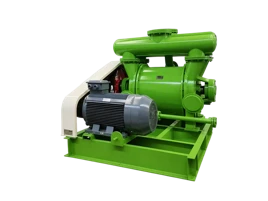
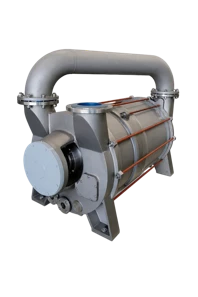
Selecting the right vacuum gauge for a high volume vacuum pump is a critical decision that can significantly impact the performance and efficiency of your vacuum system. As a high volume vacuum pump supplier, we understand the importance of this choice and are here to guide you through the process. In this blog post, we will discuss the key factors to consider when selecting a vacuum gauge, different types of vacuum gauges available, and how to match them with our high volume vacuum pumps such as the 2BV Liquid Ring Vacuum Pump, 2BED 2 Stage Liquid Ring Vacuum Pump, and 2BE3 Large Liquid Ring Vacuum Pump.


Key Factors to Consider
1. Vacuum Range
The first and most important factor to consider is the vacuum range of your high volume vacuum pump. Different vacuum processes require different levels of vacuum, and the gauge you choose must be able to accurately measure the pressure within that range. For example, if your pump is designed to operate in the rough vacuum range (typically from atmospheric pressure down to about 1 mbar), you will need a gauge that can provide accurate readings in this range. On the other hand, if your application requires high or ultra - high vacuum levels (below 10^-3 mbar), a different type of gauge will be necessary.
Our high volume vacuum pumps, such as the 2BV, 2BED, and 2BE3 series, cover a wide range of vacuum levels. The 2BV Liquid Ring Vacuum Pump is suitable for rough vacuum applications, while the 2BED 2 Stage Liquid Ring Vacuum Pump can achieve lower pressures, making it suitable for more demanding processes. The 2BE3 Large Liquid Ring Vacuum Pump is designed for high - volume applications in the rough to medium vacuum range.
2. Accuracy
Accuracy is crucial when it comes to vacuum measurement. The level of accuracy required depends on the specific application. In some industrial processes, a relatively low accuracy may be acceptable, while in scientific research or semiconductor manufacturing, high accuracy is essential. Make sure to choose a gauge with an accuracy that meets the requirements of your application.
3. Response Time
The response time of a vacuum gauge is the time it takes for the gauge to register a change in pressure. In applications where rapid changes in pressure occur, a gauge with a fast response time is necessary. For example, in a high - speed vacuum packaging process, the gauge needs to quickly detect pressure changes to ensure proper operation.
4. Compatibility
The gauge must be compatible with the gas or vapor present in the vacuum system. Some gauges are sensitive to certain gases or vapors, which can affect their accuracy or even damage the gauge. For example, some gauges may not be suitable for use in systems containing corrosive gases.
5. Cost
Cost is always a consideration. There is a wide range of prices for vacuum gauges, depending on their type, accuracy, and features. While it is important to stay within your budget, remember that investing in a high - quality gauge can save you money in the long run by providing accurate measurements and reducing the risk of system failures.
Types of Vacuum Gauges
1. Pirani Gauges
Pirani gauges are based on the principle that the thermal conductivity of a gas is related to its pressure. As the pressure decreases, the thermal conductivity of the gas also decreases. A heated wire in the gauge loses heat to the surrounding gas, and the change in the resistance of the wire is measured to determine the pressure.
Pirani gauges are suitable for measuring pressures in the rough to medium vacuum range (from about 10^-3 mbar to atmospheric pressure). They are relatively inexpensive, have a fast response time, and are easy to use. They are a good choice for applications using our 2BV Liquid Ring Vacuum Pump, which operates in the rough vacuum range.
2. Thermocouple Gauges
Thermocouple gauges work on a similar principle to Pirani gauges. They measure the change in temperature of a heated element due to the heat transfer to the surrounding gas. The output voltage of the thermocouple is proportional to the pressure.
Thermocouple gauges are also used for measuring rough to medium vacuum pressures. They are generally less expensive than Pirani gauges but may have a slightly lower accuracy.
3. Capacitance Manometers
Capacitance manometers measure pressure by detecting the deflection of a diaphragm due to the pressure difference across it. The change in capacitance of the diaphragm is measured and converted into a pressure reading.
Capacitance manometers are highly accurate and can measure pressures from atmospheric down to about 10^-4 mbar. They are often used in applications where high accuracy is required, such as in vacuum coating processes. They can be a good choice for applications using the 2BED 2 Stage Liquid Ring Vacuum Pump, which can achieve lower pressures.
4. Ionization Gauges
Ionization gauges are used for measuring high and ultra - high vacuum levels. They work by ionizing the gas molecules in the vacuum chamber and measuring the resulting ion current. There are two main types of ionization gauges: hot - cathode and cold - cathode gauges.
Hot - cathode ionization gauges are more accurate but are also more expensive and require more maintenance. Cold - cathode ionization gauges are less accurate but are more rugged and have a longer lifespan. These gauges are not typically used with our rough - to - medium vacuum pumps like the 2BV, 2BED, and 2BE3 series.
Matching Gauges with Our High Volume Vacuum Pumps
2BV Liquid Ring Vacuum Pump
For the 2BV Liquid Ring Vacuum Pump, which operates in the rough vacuum range, a Pirani gauge or a thermocouple gauge is a suitable choice. These gauges can accurately measure the pressure within the operating range of the 2BV pump and are relatively inexpensive. They also have a fast response time, which is beneficial in applications where the pump may experience rapid changes in pressure.
2BED 2 Stage Liquid Ring Vacuum Pump
The 2BED 2 Stage Liquid Ring Vacuum Pump can achieve lower pressures than the 2BV pump. For this pump, a capacitance manometer may be a better option, especially if high accuracy is required. The capacitance manometer can accurately measure the lower pressures achieved by the 2BED pump, making it suitable for more demanding applications.
2BE3 Large Liquid Ring Vacuum Pump
The 2BE3 Large Liquid Ring Vacuum Pump is designed for high - volume applications in the rough to medium vacuum range. Similar to the 2BV pump, a Pirani or thermocouple gauge can be used for most applications. However, if higher accuracy is needed, a capacitance manometer can also be considered.
Conclusion
Selecting the right vacuum gauge for your high volume vacuum pump is a complex but important decision. By considering factors such as vacuum range, accuracy, response time, compatibility, and cost, and understanding the different types of vacuum gauges available, you can make an informed choice. Our high volume vacuum pumps, including the 2BV Liquid Ring Vacuum Pump, 2BED 2 Stage Liquid Ring Vacuum Pump, and 2BE3 Large Liquid Ring Vacuum Pump, offer a wide range of options for different vacuum applications.
If you are unsure which vacuum gauge is the best fit for your high volume vacuum pump, our team of experts is here to help. We can provide you with detailed information and guidance to ensure that you select the right gauge for your specific needs. Contact us today to discuss your requirements and start the procurement process.
References
- Leck, D. (1987). Vacuum Technology. Chapman and Hall.
- Roth, A. (1990). Vacuum Technology: Fundamentals and Applications. North - Holland.
- O'Hanlon, J. F. (2003). A User's Guide to Vacuum Technology. Wiley - Interscience.