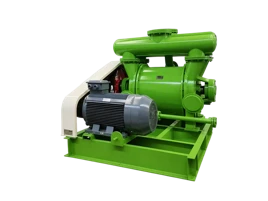
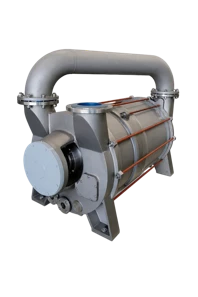
As a supplier of ATEX screw vacuum pumps, I've witnessed firsthand the importance of understanding the differences between direct - drive and belt - drive systems in these pumps. These two types of drive mechanisms play a crucial role in the performance, efficiency, and maintenance of ATEX screw vacuum pumps, which are widely used in various industries, especially those with strict safety requirements due to potentially explosive atmospheres.
1. Working Principle
Let's start with the basics of how direct - drive and belt - drive ATEX screw vacuum pumps operate.
In a direct - drive ATEX screw vacuum pump, the motor is directly connected to the pump's rotors. This direct coupling eliminates the need for intermediate components such as belts and pulleys. The motor's shaft is usually connected to the pump shaft through a rigid coupling, allowing for a one - to - one transfer of power. This setup ensures that the rotational speed of the motor is directly translated to the pump rotors. For example, if the motor runs at 1500 RPM, the pump rotors will also rotate at 1500 RPM. This direct power transfer results in a highly efficient energy conversion, as there is minimal power loss between the motor and the pump.
On the other hand, a belt - drive ATEX screw vacuum pump uses a belt and pulley system to transfer power from the motor to the pump rotors. The motor drives a pulley, which is connected to another pulley on the pump shaft via a belt. The ratio of the diameters of the two pulleys determines the speed at which the pump rotors rotate relative to the motor. For instance, if the motor pulley has a smaller diameter than the pump pulley, the pump rotors will rotate at a lower speed than the motor. This system provides a certain degree of flexibility in adjusting the pump's rotational speed, which can be beneficial in some applications.
2. Performance
2.1 Efficiency
Direct - drive ATEX screw vacuum pumps generally offer higher energy efficiency. Since there are no belts or pulleys involved, there is no energy loss due to belt slippage or friction between the belt and the pulleys. This means that a larger proportion of the electrical energy consumed by the motor is converted into useful work in the pump. In industrial settings where energy costs are a significant concern, direct - drive pumps can result in substantial savings over time.
Belt - drive pumps, however, may experience some energy losses. Belt slippage can occur, especially if the belt is not properly tensioned or if it is worn out. This slippage reduces the efficiency of power transfer from the motor to the pump. Additionally, the friction between the belt and the pulleys generates heat, which is also a form of energy loss.
2.2 Speed Control
Belt - drive ATEX screw vacuum pumps have an advantage when it comes to speed control. By changing the size of the pulleys, the rotational speed of the pump rotors can be easily adjusted. This is useful in applications where the pumping speed needs to be varied according to the process requirements. For example, in a chemical process where the vacuum level needs to be adjusted at different stages, a belt - drive pump can be tuned to provide the appropriate pumping speed.
Direct - drive pumps, on the other hand, have a fixed speed determined by the motor's design. While some motors can be controlled using variable frequency drives (VFDs) to adjust the speed, this adds to the complexity and cost of the system.
2.3 Vibration and Noise
Direct - drive ATEX screw vacuum pumps tend to produce less vibration and noise. The direct connection between the motor and the pump reduces the number of moving parts, which in turn reduces the sources of vibration. Less vibration also means less wear and tear on the pump components, leading to a longer service life.
Belt - drive pumps may generate more vibration and noise due to the movement of the belts and the interaction between the pulleys. The belts can also create a humming or squealing noise, especially if they are not properly maintained.
3. Maintenance
3.1 Direct - drive Pumps
Direct - drive ATEX screw vacuum pumps have a relatively simple design, which makes maintenance easier in some aspects. There are no belts to replace or tension, and there are fewer components that can wear out. However, if a problem occurs with the motor or the coupling, it can be more difficult and costly to repair. Since the motor is directly connected to the pump, accessing the motor for maintenance or replacement may require disassembling a significant portion of the pump.
3.2 Belt - drive Pumps
Belt - drive ATEX screw vacuum pumps require regular maintenance of the belt and pulley system. The belts need to be checked for wear and proper tension regularly. Over time, belts will stretch and may need to be replaced. If the belts are not replaced in a timely manner, they can break, causing the pump to stop working. Additionally, the pulleys need to be inspected for damage or misalignment, which can also affect the performance of the pump. However, compared to direct - drive pumps, the components of the belt - drive system are generally easier and less expensive to replace.
4. Application Suitability
4.1 Direct - drive Pumps
Direct - drive ATEX screw vacuum pumps are well - suited for applications where high efficiency and low vibration are critical. They are commonly used in industries such as semiconductor manufacturing, where a stable and clean vacuum environment is required. In these applications, the high - precision operation of the direct - drive pump ensures consistent vacuum performance, which is essential for the quality of the products being manufactured.


4.2 Belt - drive Pumps
Belt - drive ATEX screw vacuum pumps are more suitable for applications where speed control is important. They are often used in chemical and pharmaceutical industries, where the pumping speed needs to be adjusted according to the different stages of the production process. The flexibility of the belt - drive system allows for easy adaptation to changing process requirements.
5. Our Product Offerings
As a supplier of ATEX screw vacuum pumps, we offer both direct - drive and belt - drive models to meet the diverse needs of our customers. In addition to our screw vacuum pumps, we also provide a range of related products such as the ZJP Roots Vacuum Pump, ZJQ Gas circulation - cooled Roots Pump, and NZJP Multistage Roots Vacuum Pump. These products can be used in combination with our ATEX screw vacuum pumps to create a comprehensive vacuum system that meets the specific requirements of your application.
If you are in the market for ATEX screw vacuum pumps or related products, we encourage you to contact us for a detailed consultation. Our team of experts can help you determine the most suitable pump type and configuration for your needs, taking into account factors such as performance, efficiency, maintenance, and cost. Whether you need a direct - drive pump for high - efficiency operation or a belt - drive pump for speed control, we have the solutions to meet your requirements.
References
- "Vacuum Technology Handbook", edited by Peter Pfeiffer.
- "Industrial Vacuum Pumps: Principles, Operation, and Maintenance" by John Smith.